Friday, May 18, 2007

Satan's Throne - Part 6

[This is the conclusion of a six-part series originally posted on the blog of St. Cuthbert's Episcopal Church, Oakland, California, in February 2006. I am posting it here on my own blog to share my thoughts with a new audience.]
My high school history and humanities teacher, Alan Amend, awakened in me a love of history. My interest in it has its crests and troughs, but it has endured. One of the peaks was toward the end of my (first) seminary years when I had visions of becoming a Church history professor. I began a graduate program in history at UCLA that did not last long. Although I concluded that such an intense academic focus was not for me, my gratitude for those extra years in history had endured. History gives us a sense of perspective that spans continents and millennia.

The awareness of prior generations with their various challenges, triumphs, and defeats can liberate us from assuming that we are the first or last or best to wrestle with anything. or that ours is the definitive frame of reference. So it has come to pass that I view the current parade of events both grateful to be living when I do and aware that we are but one of history's many chapters. Even in my teens and twenties I was drawn to the sobering reminders of poets.

“My name is Ozymandias, King of Kings:
Look upon my works, ye Mighty, and despair!”
Percy Bysshe Shelley

We are the greatest city,
the greatest nation:
nothing like us ever was.
—Carl Sandburg, “Four Preludes on Playthings of the Wind” (1922)

Taken out of context the quotations above suggest grandeur, but the poems in their entirety are sobering challenges to hubris, the pride that is the seed of downfall in the ancient Greek tragedies. Shelley’s Ozymandias speaks of the shattered remains of this great king’s statue and concludes as follows:

Nothing beside remains. Round the decay
Of that colossal wreck, boundless and bare
The lone and level sands stretch far away.


Sandburg, writing a century after Shelley’s death, speaks of crows and rats in deserted ruins, concluding thus:


And the wind shifts
and the dust on a door sill shifts
and even the writing of the rat footprints
tells us nothing, nothing at all
about the
greatest city, the greatest nation
where the strong men listened
and the women warbled: Nothing like us ever was.

What, then, endures if great civilizations fall to dust and ruin, or are swallowed up by vegetation and forgotten? What will our legacy be?


“Do not store up for yourselves treasures on earth, where moth and rust consume
and where thieves break in and steal; but store up for yourselves treasures in
heaven, where neither moth nor rust consumes and where thieves do not break in
and steal.” (Matthew 6:19-20)

It would seem that Caesar’s standards are not those of Jesus. Enduring riches or fame are stored up “in heaven” or in God. In ordinary terms we think of grass withering but gold enduring, yet St Paul’s first letter to the Corinthians reminds us that it is faith, hope, and love that endure.

I find it both amusing and deeply chilling to read the words of Gary Schmitt in a memorandum from January 2001: “…[T]he preservation of a decent world order depends chiefly on the exercise of American leadership.” This is part of a discussion about the International Criminal Court and its rejection by participants in the Project for a New American Century (PNAC). What troubles me about the sentence is the idea that American leadership, no matter how important in globally politics, would be a chief element in the preservation of a decent world order. It implies that without one particular nation there would be little hope of decent order in the world, as though one nation either controlled or guaranteed decency or order! “Nothing like us ever was,” I hear in the background, as rats and lizards listen (but they do not applaud and cheer).


Not by might, nor by power, but by my spirit, says the LORD of hosts. (Zechariah 4:6)

That which gives value to our lives and is of lasting value is not the monuments we erect but the love we share, the justice we do, and the mercy we show.

In spite my own political biases, this is not a partisan rant. It does not matter which political party is ascendant, what the affiliation of any current President, which factions control Congress, what ideologies appeal to those whose wealth and influence shape the fate of millions. My concern here is with human choices, human actions, and their consequences for the average denizen of the earth. As an American, my concern is with the behavior of the United States as it embodies the dreams and the principles of our Declaration of Independence, Constitution, and Bill of Rights. As a Christian, my concern is with how those of us who seek to follow Christ, or claim that we do, actually make decisions, take actions, cast votes, speak up, or remain passive when the collective reality of our government—a government designed to be “of the people, by the people, and for the people—shapes the lives and fates of our citizens and of the rest of the world’s inhabitants.

Do we choose Jesus or Caesar? The way of love or the way of power? The way of reconciliation or the way of vengeance? The way of justice or the way of personal aggrandizement? Grasping or sharing? Judging or understanding? Advantage or mutuality? Greed or generosity? Hospitality or hostility? Peace or war? Sustainability or exploitation? Liberation or oppression? Hope or fear? Hearts that are open or closed? Truth or deceit? Integrity or corruption?

To say “Jesus is Lord” is to relativize all other claims to our allegiance. Caesar cannot be Lord if Jesus is, and neither can anyone else, including corporate entities. Not a governmental figure nor a company. Those who have been “sealed by the Holy Spirit in baptism and marked as Christ’s own for ever” cannot owe their soul to the “company store.” Those delivered from bondage in Egypt do not return to Pharaoh. Those set free by Christ do not belong to anyone less than God. Do we then act as God’s people?

Do we speak out? Do we stand up? Or do we sit back and wait for God to sort it all out, when God is waiting for us to join in God’s work and be the Body of Christ in our time? Do remember that Jesus does not call us that we may be comforted but that we may be transformed and become agents of God’s love, healing, and grace?

We remember Jesus’ sense of mission:
When he came to Nazareth, where he had been brought up, he went to the synagogue on the sabbath day, as was his custom. He stood up to read, and the scroll of the prophet Isaiah was given to him. He unrolled the scroll and found the place where it was written: "The Spirit of the Lord is upon me, because he has anointed me to bring good news to the poor. He has sent me to proclaim release to the captives and recovery of sight to the blind, to let the oppressed go free, to proclaim the year of the Lord's favor." And he rolled up the scroll, gave it back to the attendant, and sat down. The eyes of all in the synagogue were fixed on him. Then he began to say to them, "Today this scripture has been fulfilled in your hearing." (Luke 4:16-21)


Do we accept our own?
Jesus said to them again, "Peace be with you. As the Father has sent me, so
I send you." (John 20:21)


There is work to be done. The average American worker earns less in constant dollars than several years ago. A huge segment of our population has no health insurance. The gap between rich and poor is swelling. Huge breaks are given to industries making immense profits while budget cuts penalize the already marginalized. The laws of the land are being flouted by those charged specifically with enforcing them. Basic human rights are being treated as optional. There are ethical and spiritual principles at stake in how we behave as a society, and I am not speaking here of individual morality but of the demonstrable fate of the many. A vision of the commonweal, the collective good, is something that has been diminishing over the decades, and that is something that flies in the face of the Gospel of Jesus Christ.

To do justice, love mercy, and walk humbly with God (Micah 6:8) is NOT to be doormats for Jesus. Note that we walk humbly with God, we do not let others ride over us roughshod. Those who do justice and love mercy are not wimps who watch in silence while injustice takes place.

I issue no call here to establish a theocracy in our land. That would be an abomination. But we have a responsibility to help shape the direction of our cities, our states, our nation.

My sisters and brothers, we decide every day of our lives. Which shall it be?

Caesar?

Or Jesus?

Previous installments:
Part 1
Part 2
Part 3
Part 4
Part 5

Satan's Throne - Part 5

In the best tradition of Hebrew prophets, Jesus was a threat to the social order. His teachings defied accepted wisdom, he hung out with all manner of outcasts, his interactions with women were remarkable for that time, and his message carried an egalitarian flavor. He defied religious traditions and placed people above rules, above profits, above power. Religious leaders considered him a heretic and blasphemer, and Rome eyed him as a potential insurrectionist. Talk of an alternative reign to that of Caesar was not acceptable on any level. His rejection of every form of exploitation challenged the way things were. Jesus was a troublemaker.

The new society that he proclaimed was a threat to entrenched structures. Alliances of “church” and state that worked for mutual enrichment of the very few at the apex of the social structure and left all others at their mercy had no place for Jesus alternate vision.

By now, no matter how intriguing this background may be to some, the reader is wondering why I have spent so much time on it all. Well, here is where the rubber hits the road.

What do these competing visions have to do with our lives today? Where do we see the way of Jesus and the way of Caesar? How do they operate and how do we disentangle ourselves from the way of Caesar in order to follow Jesus?

An empire built on military force has been tried throughout the millennia, but no matter what divine blessings they invoke upon themselves, the Law, the Prophets, the Writings, the Gospels, the Epistles, and the Apocalypse all call empires to account before God. They must give an account of how they treat the least among them, for Jesus’ parable of the sheep and the goats is, if we trust what Matthew writes, a judgment not only of individuals but of nations.

All the nations will be gathered before him, and he will separate people one
from another as a shepherd separates the sheep from the goats, and he will put
the sheep at his right hand and the goats at the left. (Matthew
25:32-33)


Hillel the Elder, whose life overlapped that of Jesus, preceded Jesus in noting the criterion of pleasing God:
That which is hateful to you, do not do to your neighbor. That is the whole Torah; the rest is the explanation. Go and study it. (Babylonian Talmud, tractate Shabbat 31a)


Jesus spoke similarly:

When the Pharisees heard that he had silenced the Sadducees, they gathered together, and one of them, a lawyer, asked him a question to test him. "Teacher, which commandment in the law is the greatest?" He said to him, "'You shall love the Lord your God with all your heart, and with all your soul, and with all your mind.' This is the greatest and first commandment. And a second is like it: 'You shall love your neighbor as yourself.' On these two commandments hang all the law and the prophets." (Matthew 22:34-40)


Empires are not run on love. The reign of God is. Since we cannot equate earthly nations and empires with the reign of God, I do not propose we evaluate them in terms of love. But I do believe we must hold them to the standard of justice, and that involves treatment of the “last and least.”

The friends and followers of Jesus should be working for liberation of the oppressed, care of the sick, feeding of the hungry, shelter for the homeless, equitable treatment of the marginalized. Jesus did not treat anyone as dispensable or irrelevant.
What does it say for our nation if laws are passed and budgets structured that favor insurers over the insured, pharmaceutical giants over the sick, energy conglomerates over those who cannot afford fuel to get to work or heat for their homes, banks and financial institutions over their customers? How can we brag of higher standards for our schools when we do not provide the means to meet those standards and the attention our children need to learn and thrive? How can we leave the people one of America’s great cities to languish while bragging about our efforts to rebuild New Orleans? How can we extend the service of our troops in battle and cut spending on the Veteran’s Administration that cares for them when they come home? How can we send young men and women to fight for the United States when do not provide them with adequate armor? How can we reduce society’s safety net for the poorest while the gap between rich and poor widens obscenely and the level of those living below the poverty line increases?

Where are our national priorities when we extend our military and economic presence without taking care of our own poor, sick, elderly, and young? Why are we reducing the burden on the very wealthy while increasing it for everyone else? What does it say about the value we place on our children and our children’s children when the nation goes deeper and deeper into debt?

What does the way of Jesus have to say about corruption, secrecy, and lies? Where are today’s prophets who will stand up and speak boldly on behalf of the dispossessed? Who will be our next Martin Luther King, Jr.? Our Mohandas Gandhi? Our Desmond Tutu? Our Oscar Romero? Our Harriet Tubman or Elizabeth Cady Stanton? Our Chief Joseph or Sealth? Our Isaiah, Amos, Micah, Hosea? Our Mary?

When the Soviet Union held nations under its thumb with ruthless brutality and suppressed all freedoms, Ronald Reagan named it an Evil Empire. The Soviet Union collapsed and for the moment there is one superpower on the planet, though China may be able to challenge that before long. Have we become an empire or aspire to do so? What does this say about our Declaration of Independence, our Constitution, and our Bill of Rights? What are our national ideals today, our goals? If it is our deeds that tell the truth and not our words, where do we stand?

I believe Jesus challenges us today to remake our society. That does not mean we can create the reign of God on our own and it certainly does not mean we should restructure our nation to conform to ours or any other belief system. It does mean we, as Christians, have a duty to help shape the structures of our society so they favor justice, freedom, and the common good. We must oppose injustice, oppression, and the greed and lust for power that ignores the wellbeing of all. Jesus or Caesar—whom do we serve?

Conclusion in Part 6

Satan's Throne - Part 4

[Crossposted from St. Cuthbert's, Oakland, blog. Part 4 of 6]

The Bible’s contrast between Christ and empire is stark. For all the imagery of the ideal deliverer and ruler that derives from the propaganda machine of the Davidic dynasty, the early Christians radically redefine the notion of God’s Anointed (Messiah/Christ). Their experience of Jesus did not fulfill messianic expectations. David delivered Israel from the threat of the Philistines and expanded Israel’s borders. Jesus did not deliver the people from Rome’s grip nor did he establish a worldly kingdom. From all appearances, his kingship was a joke and it was mocked. Many of the most vivid images of the Passion involve brutal jests related to his supposed sovereignty: the crown of thorns, the robe, the title Pilate had placed on the cross (Jesus of Nazareth, King of the Jews), and the taunts of the onlookers.
"Jesus of Nazareth, King of the Jews"
Rome’s rule was brutal and it is difficult to envision any empire maintaining a hold on the nations without strong and savage force. Crucifixion was a method of execution intended not merely to kill the most heinous criminals and threats to Roman rule, it was meant to humiliate and to warn. It was a form of blatant terrorism. A person was stripped, nailed to a cross, and left not only to asphyxiate slowly and painfully (or perish from dehydration or shock) but also to hang there and rot, a reminder to all passersby that this is what happens to those who oppose Rome. Crucifixion was designed to instill fear and horror, to quench any flickering dreams of opposing the empire. Rome’s message was clear to all: This is what we think of your “king.”

Indeed, the evangelists themselves take great pains to establish contrasts. What sort of king is born and laid in a feeding trough? What sort of king’s birth is announced not in palaces but to shepherds, persons involved in a semi-unclean occupation? If Augustus can order the known world to participate in a census, what can this Jesus do? What does it mean to give Caesar what is Caesar’s and give God what belongs to God? What sort of messiah gathers no army? Indeed, what sort of fool heads straight to Jerusalem, where all his enemies await, and does nothing to evade capture and execution?

As far as Rome was concerned, one more potential troublemaker has been dealt with, one more wannabe threat eliminated. But what sort of threat to Rome did Jesus pose?
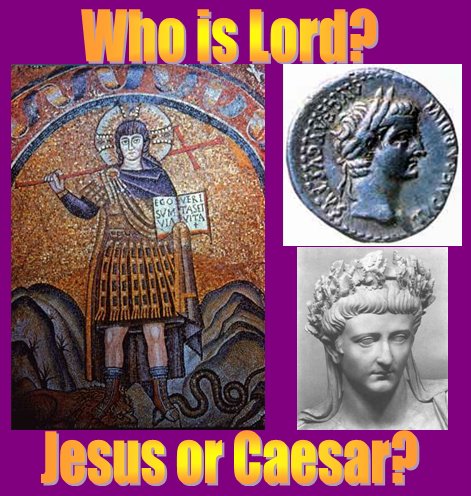
Tiberius and Jesus: Crown of Laurel, Crown of Thorns

Luke draws on the Song of Hannah and gives us a hint in the Song of Mary (Magnificat).

[God] has shown strength with his arm; he has scattered the proud in the thoughts of their hearts. He has brought down the powerful from their thrones, and lifted up the lowly; he has filled the hungry with good things, and sent the rich away empty. (Luke 1:51-53)


This proclamation of God’s character expressed in action speaks clearly of social reversals. Had Mary been speaking in the 20th century, she may have begun with “come the revolution….” When Jesus said “the last will be first, and the first will be last,” he was not upholding the status quo. (Matthew 20:16)

It is one thing to hear a person read a passage from Isaiah in the synagogue—"The Spirit of the Lord is upon me, because he has anointed me to bring good news to the poor. He has sent me to proclaim release to the captives and recovery of sight to the blind, to let the oppressed go free, to proclaim the year of the Lord's favor," and another to hear the reader then assert, "Today this scripture has been fulfilled in your hearing." (Luke 4:18-21)
The Coronation of Jesus from an early Christian sarcophagus

Good news for the poor almost always means bad news for those who live off the toil of the poor. Higher wages mean lower profits and those who are especially fond of high profits will resist raising a worker’s pay any more than necessary. When you are dealing with the economy of the ancient Mediterranean world where all but a few percent of the population were peasants living in or near poverty, the landowners and employers held all the cards. There was no union and no power that would uphold the lot of the poor. Except for one: God. The God of Israel had expressed a concern for the marginalized throughout the Hebrew Scriptures. The poor, the widow, the orphan, the alien—these were mentioned again and again as being dear to Yahweh. They were not to be forgotten, abused, or oppressed, and God was watching and judging. Job’s claim to innocence was based not on rules he had kept but on his care for exactly these people.

Jesus was following this tradition of promoting social justice in the name of God’s justice. One would think the religious authorities would have welcomed someone whose words and deeds were so in keeping with the Scriptures, so revealing of God’s character.

They, however, profited from the way things were and had an understanding with Rome. Jesus threatened their position and power just as he threatened the imperial power with words that, no matter how rooted in the Jewish tradition, sounded radical to their ears. He could only be a lawbreaker and a blasphemer. He needed to be dealt with.

Continued in Part 5

Earlier posts:

Part 1

Part 2

Part 3

Satan's Throne - Part 3


Jesus came proclaiming a different kind of rule than that of any known empire. His opening message was that “[t]he time is fulfilled, and the kingdom of God has come near; repent, and believe in the good news.” (Mark 1:15) To those around him the known rulers were Herod, the half-Jewish and half-Idumaean kinglet whose power was entirely under Roman authority, and Tiberius Caesar. What could this “kingdom of God” be? Especially one that Jesus seems to consider more important than self-preservation.

We have come to understand that Jesus used the term not to suggest territories, bureaucracies, armies, and such—the usual trappings of a kingdom—but the “reign” of God, the realization of God’s will and rule on earth. It remains a strange concept to those who never talk about it, ponder it, and wrestle with what it means in our lives here and now.

Jesus went throughout Galilee, teaching in their synagogues and proclaiming the good news of the kingdom and curing every disease and every sickness among the people. (Matthew 4:23)

Therefore do not worry, saying, 'What will we eat?' or 'What will we drink?' or 'What will we wear?' For it is the Gentiles who strive for all these things; and indeed your heavenly Father knows that you need all these things. But strive first for the kingdom of God and [God’s] righteousness, and all these things will be given to you as well. (Matthew 6:31-33)

Jesus said, "Let the little children come to me, and do not stop them; for it is to such as these that the kingdom of heaven belongs." (Matthew 19:14)
It is not a reign of coercion, though God might well make any and all claims on us creatures. Jesus does not impose; he proclaims and invites. Some respond with faith and follow him. Some respond with doubt or conflicting values and do not follow. Some respond with fear or anger and resist Jesus and what he announces. Jesus’ way is not the way of empire. As God spoke to King Zerubbabel through the prophet Zechariah: “Not by might, nor by power, but by my spirit, says the LORD of hosts.” (Zech. 4:6)

Jesus answered [Pilate], "My kingdom is not from this world. If my kingdom were from this world, my followers would be fighting to keep me from being handed over to the [Jewish leaders]. But as it is, my kingdom is not from here." (John 18:36)
It is not a reign based on getting and keeping but on giving. The point of riches is to use them for the common good, to share with those who have not. This is not the way of modern commerce or individual estate planning. Jesus proclaimed an “estate plan” that laid up treasures on another level altogether, where moth, rust, thieves, the stock market, and the IRS can do no harm. Caesar and his far-flung tax collectors would not understand.

"You lack one thing; go, sell what you own, and give the money to the poor, and you will have treasure in heaven; then come, follow me." (Mark 10:21)

"Do not store up for yourselves treasures on earth, where moth and rust consume and where thieves break in and steal; but store up for yourselves treasures in heaven, where neither moth nor rust consumes and where thieves do not break in and steal. For where your treasure is, there your heart will be also.” (Matthew 6:19-21)

He said also to the one who had invited him, "When you give a luncheon or a dinner, do not invite your friends or your brothers or your relatives or rich neighbors, in case they may invite you in return, and you would be repaid. But when you give a banquet, invite the poor, the crippled, the lame, and the blind. And you will be blessed, because they cannot repay you, for you will be repaid at the resurrection of the righteous." (Luke 14:12-14)

Then he looked up at his disciples and said: "Blessed are you who are poor, for yours is the kingdom of God. (Luke 6:20)
It is not a reign of exploitation. The God of Israel is known first and foremost for setting slaves free. The Exodus is the foundational story for the people of Israel, telling of their origin as a people and the God who gave them an identity.

“I am the LORD your God, who brought you out of the land of Egypt, out of the house of slavery.” (The first “commandment” of the Decalogue—Exodus 20:2)

You shall not wrong or oppress a resident alien, for you were aliens in the land of Egypt. (Exodus 22:21)

When an alien resides with you in your land, you shall not oppress the alien. The alien who resides with you shall be to you as the citizen among you; you shall love the alien as yourself, for you were aliens in the land of Egypt: I am the LORD your God. (Leviticus 19:33-34)

Happy are those whose help is the God of Jacob, whose hope is in the LORD their God, who made heaven and earth, the sea, and all that is in them; who keeps faith forever; who executes justice for the oppressed; who gives food to the hungry. The LORD sets the prisoners free; the LORD opens the eyes of the blind. The LORD lifts up those who are bowed down; the LORD loves the righteous. The LORD watches over the strangers; he upholds the orphan and the widow, but the way of the wicked he brings to ruin. (Psalm 146:5-9)

"The Spirit of the Lord is upon me, because he has anointed me to bring good news to the poor. He has sent me to proclaim release to the captives and recovery of sight to the blind, to let the oppressed go free, 19 to proclaim the year of the Lord's favor." (Luke 4:18-19)
It is not a reign of dominion or division. The path which Jesus calls us to follow is one that rejects the artificial distinctions that we use to define the “other” and create division. Without such distinctions it is difficult to justify one person lording it over another. This does not entail a rejection of all authority but clearly implies an end to the abuse of power. Arrogance and servility alike have no place in God’s reign. In this Jesus follows the best traditions of the Torah, the prophets, the psalmists, and the sages.

You shall not steal; you shall not deal falsely; and you shall not lie to one another. And you shall not swear falsely by my name, profaning the name of your God: I am the LORD. You shall not defraud your neighbor; you shall not steal; and you shall not keep for yourself the wages of a laborer until morning. You shall not revile the deaf or put a stumbling block before the blind; you shall fear your God: I am the LORD. You shall not render an unjust judgment; you shall not be partial to the poor or defer to the great: with justice you shall judge your neighbor. You shall not go around as a slanderer among your people, and you shall not profit by the blood of your neighbor: I am the LORD. You shall not hate in your heart anyone of your kin; you shall reprove your neighbor, or you will incur guilt yourself. You shall not take vengeance or bear a grudge against any of your people, but you shall love your neighbor as yourself: I am the LORD. (Leviticus 19:11-18)

You shall have one law for the alien and for the citizen: for I am the LORD your God. (Leviticus 24:22)

“I do not call you servants any longer, because the servant does not know what the master is doing; but I have called you friends, because I have made known to you everything that I have heard from my Father.” (John 15:15)

There is no longer Jew or Greek, there is no longer slave or free, there is no longer male and female; for all of you are one in Christ Jesus. (Galatians 3:28)
Continued in Part 4

Previous posts:
Part 1
Part 2

Satan's Throne - Part 2

The Pergamene martyr Antipas was among those persecuted, evidently for refusing to worship the emperor. To most Romans this was a formality similar to reciting the pledge of allegiance to the flag, but to Christians it involved calling Caesar “Lord” and acknowledging the emperor’s divinity. The mere act of tossing a few grains of incense on the fire before the emperor’s statue was, to devout Christians whose religious roots were in Judaism, an act of apostasy and idolatry. Jews had been exempted from this civic ritual as the empire had realized their faith, unlike all the other known religions, would simply not allow it. But Christians, once they had been evicted from the synagogues as no longer being authentically Jewish, did not have this exemption.

The entire book of the Apocalypse is riddled with references to the question of whether Jesus is Lord or Caesar is Lord. Whose is the ultimate power? Who is truly divine? Who has the last word? Whose is the final victory? John’s pastoral answer is clear: Jesus is Lord and his is the victory. Those who remain faithful to Christ will share in his victory. The way of the empire is the way of death but the way of Christ is life.

What are these two contrasting paths?

The way of empire is always the way of power. Influence is extended through military and economic means, taking advantage of geography and natural and human resources. Cultural and ideological tendencies are yoked to political intent. Propaganda is nothing new, though sometimes it is subtle. The masterful Roman poet P. Vergilius Maro (Vergil or Virgil) managed, through no accident, to flatter the emperor Augustus through the epic Aeneid, a poem that traces Rome’s heritage back to the Trojans who survived the fall of Troy and many perils and temptations thereafter on their journey to Italy. The story of Aeneas and his travels provides a myth that shapes Roman values and legitimizes the Julian line currently in power, for Aeneas was the son of the Trojan Anchises and the goddess Venus, and his son Iulus gave his name, so the story goes, to the clan of Julius Caesar. The imperial line is divine and divinely favored and Rome’s glory under Augustus prophesied. The skeptics among us will note that the epic poem was written in the time of Augustus, thus making it one of those prophecies after the fact, or vaticinia ex eventu (to use the technical term). A mere quibble. Ignore the man behind the propaganda curtain.

The Roman colisseum in Nîmes, France, where I spent an afternoon in autumn 1967. Still functional after all these years.


Roman aqueduct over the Gard River in Provence (Pont du Gard)

The Roman temperament favored organization, discipline, and bureaucracy. A tension existed between a recognition of rule by law and the whim of some rulers, to be sure, but an empire-wide consistency could be achieved. The Roman army was well trained, Roman engineers were skilled. Roads, aqueducts, and buildings constructed two thousand years ago still stand. I got to watch a non-lethal bull fight in the city of Nîmes, sitting in a coliseum built by the Romans and still fully functioning. What especially amazed me was that thousands of people could exit in minutes, something I would never see in a modern structure.

Even with the temperate Roman climate and various societal traits, the Roman Empire was built with the toil of slaves, shrewd commerce, and military might. Slaves in the City of Rome itself are estimated to have been one third the total population.

Everything about Jesus challenged the society he lived in. Most Christians are aware of the challenges Jesus posed to Jewish religious authorities and the traditions that had grown up over the centuries and become dear to the scribes, Pharisees, Sadducees, Herodians, and priests. These conflicts and Jesus’ position with respect to them are widely taught and preached. The political conflicts are discussed less and this shortchanges the Gospel.

Satan's Throne - Part 1

[I am reposting this series from the blog of St. Cuthbert's Episcopal Church, Oakland, California, where I posted them in February 2006. Just wanted them on my own blog, especially since the daily choice between death and life is ever with us. The New Testament frequently illustrates that choice as the question of the imperial way of domination or Jesus' way of love and justice lived out in reciprocity.]

In a time and place where speakers and writers depict the world in harsh contrasts of black and white, of good and evil, of right and wrong, those of us who are fond of the myriad shades of gray—not to mention the countless hues of the rainbow—hesitate even to begin a discussion with mention of Satan. Immediately images arise and our most fevered fantasies and fears color anything that may follow.

For some it may be an almost comic devil, mocked in Hallowe’en costumes or as the pushover paramour of Saddam Hussein on South Park. [If you don’t catch this reference, better you should not ask.] Some others may conjure thoughts of humans caught up in satanic rituals with black masses and unspeakable sacrifices. The less fearful may envision a small bound figure, helpless at the feet of Christ harrowing hell, as depicted in Orthodox icons of the Resurrection. The operatic among us may hear tunes of Gounod’s Faust or Boito’s Mephistophele, each recounting the timeless tale of the evil compromises we make in pursuit of our goals. Still others may wish they could shake so primitive a figure in our collective mythology but hesitate before the genocidal horrors that are woven through the past century. A few may clutch their crucifix a little closer, cross themselves, of seek the nearest drop of holy water at mention of the name.

Those raised on movies from 1977 onward may picture the “dark force” of the Star Wars series or the powerfully malevolent Sauron in Lord of the Rings, for these provide a clear sense of a potent and evil will bent toward destruction and dominion, working through violence and fear to achieve its ends. In almost any case, some reptilian portion of the human brain knows that life is tenuous, dreams are fragile, and there are unnamed forces we cannot control. When night falls, or winter comes, we burn fires and huddle closer for more than physical protection or comfort. We need reassurance.


Relax, my friends. This is no dissertation on demonology, nor pondering on the metaphysics of evil. Satan is not really my theme.

“Satan’s throne,” however, is a striking phrase from the Apocalypse [Revelation] of Jesus Christ to John. The phrase has stuck with me through the years, and what I believe is the key to its meaning. It is the significance of this passage that I wish to share with you here.

In the third of the seven letters to the angels of the churches, the Alpha and Omega addresses these words:

Revelation 2:12-13, 17 "And to the angel of the church in Pergamum write: These are the words of him who has the sharp two-edged sword: "I know where you are living, where Satan's throne is. Yet you are holding fast to my name, and you did not deny your faith in me even in the days of Antipas my witness, my faithful one, who was killed among you, where Satan lives.

“Let anyone who has an ear listen to what the Spirit is saying to the churches. To everyone who conquers I will give some of the hidden manna, and I will give a white stone, and on the white stone is written a new name that no one knows except the one who receives it.”


Scholars agree that during those dangerous years of persecution John’s coded message would make sense to its recipients. We who are far removed from that context puzzle over all the rich symbolism. The language of the Apocalypse is strong and vivid, for it spoke of a violent and perilous time in the life of the earliest Christians. Depending on our temperament and taste we are likely to find it fascinating or repugnant and, upon occasion, comforting. I believe strongly that the book was written to provide comfort and encouragement in difficult days, but it not easy to recapture that message when so much codswallop has been written about it.

What did John mean by “the throne of Satan?” We can begin with what we know of ancient Pergamum and the key point is summed neatly in a resource provided by Our Father Lutheran Church in Centennial, Colorado:

Pergamum was also a center for the worship of a pantheon of pagan deities (Egyptian, Greek, Roman) and, as the provincial capital, it was the official home of the emperor worship cult, a great honor for the city and its leaders. But, twice in his letter to the church in Pergamum, John mocks the city's status as a cult center for emperor worship with the use of the phrases: "where Satan has his throne" and "where Satan lives." To John, the emperor was not a god to be worshiped, but Satan incarnate….Pergamum, as the provincial capital, was one of the few cities granted the power by Rome to inflict capital punishment. This was known as "the right of the sword." By introducing Christ as the one "who wields the sharp sword with the double edge" and as one who will fight "with the sword of (his) mouth," John was telling the Pergamum church that Christ wielded greater power than either the provincial rulers or the Roman emperors! [emphasis mine]

Five more parts to follow

Tuesday, February 20, 2007

The Loyal Opposable

Appreciating Opposition
It is a sad commonplace that we do not appreciate things until they are gone. Or at least temporarily out of commission.

Health, for instance, is a blessing we routinely take for granted until illness or injury comes along to shatter our illusion that we shall always be well (and live forever).

As primates we are endowed with an opposable thumb, something that allows us to grasp and manipulate things in ways impossible for most animals. This allows the development and increasingly sophisticated use of tools. And. So. Much. More.

Life Without Opposition [or “how I found my options restricted”]
Last Thursday I slipped while descending the stairs. No bones were broken and my back and bottom were jarred but fine. My left hand, however, had made a rather sharp contact with the stairs and my thumb hurt. It still worked, so I trusted nothing serious was amiss and resigned myself to a few days of soreness.


By nightfall the soreness made its presence well known but I minimized motion and did not worry about it. While watching television (it had to be either CSI or Law & Order), I noticed the base of my thumb was not only swollen but a roseate shade indicating some serious inflammation. I moved the thumb and noted it robust sensory feedback. Not good.

Early Friday morning I called the office of my primary care physician (thank you, Dr. Bob, for connecting me with him) and made an appointment for a couple hours later. He examined my hand, probed and wiggled my thumb, and proposed a cautious course.

Next stops: the nearest hospital for x-rays and a medical supply store for a brace to restrict thumb motion. And on Monday, a visit to an orthopedic clinic.

A severe curtailing of motion brings one up short. Grasping, applying pressure and torque, fine manipulation—bid these farewell. Over the weekend I discovered how many simple tasks were now awkward, difficult, or downright impossible. These are temporary conveniences, however.

What scared me, quite frankly, was the remote possibility of long-term limitations of thumb motion. This was my left hand: the one I eat and write and draw and paint with. (And shave with, as I was reminded today.) As an amateur artist and someone who wants to go into his later years with greater creative expressions, that is a major threat. This is why I was more than happy to jump through medical hoops and spend time in waiting rooms.

The orthopedic nurse practitioner reassured me that no bones were broken (I had looked at the x-rays myself while I had them over the weekend and was already as sure as the medically untrained could be that this was the case) and the ligament in question was not torn. [Google helped me verify that we are talking here about the ulnar collateral ligament, the one involved in “Gamekeeper’s (or skier’s) thumb,” http://www.handuniversity.com/topics.asp?Topic_ID=29 the danger my primary physician had named. I could hardly take notes during the examination while my writing hand was being manipulated.]

The downside, from the standpoint of daily activity, is that the brace was replaced with a cast to really immobilize my thumb while the injured ligament heals. I could remove the brace for meals and wet activities such as washing hands or dishes and showering. Not so the cast. It is with me night and day, no exceptions. It also restricts the motion of my fingers as I type, an uncomfortable but not insuperable matter. The brace allowed me to grasp things loosely; the cast makes all but the grosses and most awkward grasping with the left hand impossible.

The Scene of the “Crime” and The Result


You will note that, in our world of fashion options, I could choose a black cast. Well, I can hardly carry off Prussian blue or coral pink and I know that black with white trim suits my coloring well.

For any readers who have been spared the experience, consider simple matters of hygiene and attempting to accomplish them with one hand. Shaving with one’s non-dominant hand? (I only cut myself twice; not bad.) Pulling on socks. Buttoning! Buttons are such a wonderful device and fiendishly difficult without full flexibility. I also have a new limitation in wardrobe. Anything that does not fit with reasonable ease over a forearm in a cast is out of the question. And the pulling on and off can be fun even then.

Well, patient reader, you are by now asking, “What is his point?” It is this:

We need opposition to function well. Without it we are awkward, flabby, weak. Our entire musculature is based on the calibration of opposing motions. The biceps brachii flexes our arm and the triceps brachii then re-extends it. [And yes, my friends, biceps and triceps are both singular, not plural, words from Latin. Let us hear no nonsense about a “bicep”—ugh!]

When I was learning about the Four Directions from Peter Brokenleg a few years back, he spoke of the North as the direction of the North Wind that blows furiously, cleansing and strengthening us. Just as we lean into the wind, so we exert ourselves against various opposing forces. In doing so we gain strength. That is the whole point of weight training, using resistance to build our strength. The harsh wind also blows away the no longer needful, cleansing us for the next cycle of the year.

Opposition to our ideas also forces us to look at what we think, to see it from other perspectives, to analyze it more closely and carefully, to defend it, to refine it, to articulate it more clearly and with better nuance. Opposition is a refining and strengthening force.

This is being tested in the life of the Anglican Communion right now. Large bodies of people who wish to follow Christ disagree over what matters and what does not in faithful following. Their assumptions and perspectives vary widely, making it difficult if not impossible to come to agreement on how they should live out and proclaim Good News in their concrete historical situations. There is a very real question of whether the Anglican Communion will survive without major rupture.

Frankly, I do not think it will, nor can I find it within me to even pray that it will. While the benefits of honest dialogue with disagreement can force us all to question our assumptions and test our knowledge and motives, I see coercion toward conformity to be something beyond parties of “loyal opposition.” My wording exposes my bias. I see what has emerged from the Primates’ Meeting in Dar-es-salaam, Tanzania, to be a simple ultimatum. The Episcopal Church in the USA must conform to the majority view within this calendar year or there will be hell to pay.

In other words, while both sides are self-admitted imperfect, sinful groups, one side has been declared “right” and the other “wrong.” I write from the “wrong” side, having already been excommunicated by several African provinces.

I have long believed we need tension, that it is built into the universe and, if one believes in some “higher power” that it is an intentional part of the design of reality. I do not think it is necessary or desirable that one side of a polarity prevail. Most of us live most of our lives somewhere in the middle of tensions. I know I operate much better with both left and right hands, though my left is dominant.

[And a quick shout out to all the wonderful, brave men and women who have been injured in military service, to victims of conflict or accident, and to all who have to struggle with one hand, or one leg, or one eye, or none. Our wholeness as human beings is not based on our inventory of parts.]

So, I would have urged the Primates, had I the opportunity, to acknowledge that they see the Holy Spirit’s actions from differing perspectives and that though this may be painful it cannot be resolved at this time without violation of conscience on one side or the other. Since the violation of conscience, we should all be able to agree, is not of God, it cannot be our way forward. We must live in tension. It will make us all stronger and healthier in the long run and may well blow out some extraneous matter.

Let the Holy Spirit and the North Wind blow, my friends.

But do not submit your conscience to another.

—the BB

Wednesday, January 10, 2007

Night Photos

My front yard on the Tuesday before Christmas
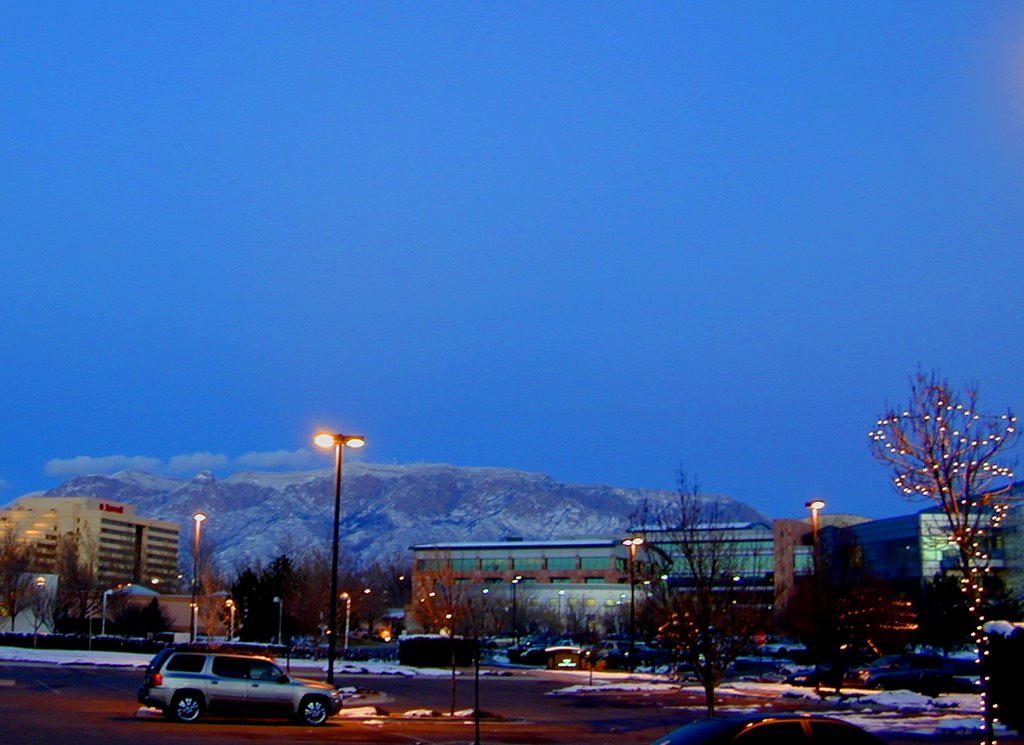
The Sandias viewed from Sun Plaza
Leaving work the week after Christmas, looking southeast...
...and northeast, between the office and the parking structure.

Monday, January 08, 2007

The Feast of the Theophany

"He Fills All Things with Blessing"
Icon of the Baptism of Christ
(c) Paul E Strid

Footsteps in the Jordan

So many sandals mask the sky
From soil and grass, while passing by—
The union of above, below,
Disjointed where we humans go.

Which blades were bent whereon he trod
Whom heaven named the Son of God?
Who can descry a mark or stain
That shows the whole world’s weight of pain?

Did angels footsteps leave a trail
From riverbank to cross and nail?
Where is the mark of holiness
Amid the crowd, the noise, the mess?

If he was consubstantial then
With mortal women, mortal men,
Would cosmic ripple shiver stars
And rock and sand show sacred scars?

Is it unfaith that dares suspect
Creative Word in flesh bedecked
Was truly human, weighed no more
Than any other on the shore?

Is truest sign that God is here
The lack of signs, the doubt and fear,
Uncertainty and sometimes dread,
And destination with the dead?

Which sons of Adam or which daughters
Of mother Eve can enter waters
Yet not be claimed as heaven’s child,
Or bear that Spirit, fierce and wild?

From dust and clay the Image, warmed
By God’s own breath and formed
To manifest Immanuel
From farthest reach to deepest hell

Cannot be lost, against all odds,
For it is named, and it is God’s.
We each and all behold the dove
Descend in fire and grace and love

To claim us and declare that we
Too bear that Word, and also see
In ordinary things of earth
God’s own true self come forth in birth.

O Holy One of mercies sure,
Whose truth and justice shall endure,
From whom the galaxies are sprung,
In whom all life is ever young,

Help us to see your presence here
In time of misery or cheer;
Your hour as now, and we your folk,
Today the breaking of each yoke.

Reveal your children, one and all,
And rend illusion’s deathly pall
Cast over eyes and minds that we,
May serve you—whole and strong and free,

Anointed as your Christ, and one
With him who is our Source, our Sun
Of Righteousness, our Light,
Our Peace and Joy, our soul’s Delight.

With Jesus in the flood we go,
With him arise, and with him know
Your will and pleasure, sin’s release,
The world’s redemption, heaven’s peace.

Renew each galaxy and quark,
Let light eternal dance with dark,
Let all creation flourish, sing
Your praises, let the cosmos ring

With everlasting Hallelu!
You dwell in us, and we in you,
The Source of all, the Word of love,
The blessing-bearing gracious Dove,

The glorious Trinity of grace,
God of each moment and each place,
Present wherever we may turn,
Whose love in all shall ever burn. Amen.

(c) 2003 Paul E Strid

Friday, January 05, 2007

The Matter of Morals

The embarrassing, shameful, unconstitutional, and reckless behavior of the George W. Bush White House can easily provoke a passionate rant. [What did we call it before making “rant” a very common noun? A tirade? A venting of anger or letting off of steam?] I have been given to such spontaneous outbursts over the past several years. It is not my intent for this to be one, but I offer this prelude to disclaim neutrality.

What is it that makes behavior moral or immoral?

This is no small question for it entails much of human reflection. I am reminded of a professor from days of yore—back when I was taking Introduction to Greek Philosophy—who spoke of two focal questions. My memory is too unreliable for any hope of reproducing the questions accurately but I believe the trustworthy substance of the questions are as follows: What is the nature of reality? How ought one to live?

These questions, for me, are the philosopher’s equivalent of the summary of the Torah given by Rabbi Hillel and Jesus. After these two questions all the rest of Greek philosophy is commentary.

The issue of morality, then, relates to the second question of how one ought to live. The faith and wisdom traditions of the centuries offer many excellent guidelines. One may ponder Hillel and Jesus in light of the Decalogue or the entire Torah. The prophets and wisdom literature of the Hebrew Scriptures have much to say about how one ought to live. Christian Scriptures can be frustratingly open-ended in terms of living according to the Spirit but they also offer the model of Jesus’ behavior and the new commandment to love one another. Socrates echoed the inscription at Delphi with the daunting imperative to know oneself. Patanjali articulated ten commitments from a Hindu perspective, Buddha offers the Eightfold Path, and Native Americans remind us to walk in a sacred manner (or walk in beauty). Most people are aware that some variant of the “Golden Rule” is part of all spiritual paths.

The tricky part is usually discerning what is good, and what is better. We turn to the many guidelines, such as those just mentioned, to help us in this discernment.
  • Knowledge of reality, knowledge of self, knowledge of the other;
  • loving the other and loving oneself (as one loves the Ultimate);
  • doing what is helpful rather than hurtful;
  • lessening suffering and enhancing wellbeing;
  • leaving behind the paths of ignorance, fear, and hatred for the ways of understanding, love, and compassion—all these help us to do the good.


Yesterday I wrote about developing compassion and the practice of kindness by understanding that others suffer as we do and they also have their own mighty struggles. It is in the common ground of our shared humanity—and at a more basic level, shared creatureliness—that we discover the ability to understand, to care, and to develop the mutuality that enables us to live together without destroying each other and ourselves.

When we think of the “amoral,” we usually envision those who either have no sense of right and wrong or, knowing the distinction, simply do not care. I believe that what usually underlies this sort of sociopathy is a missing, or at least stunted, ability to feel compassion. The amoral either cannot envision or bring themselves to care about the feelings of others. The suffering of another person or the destruction of our planet: these are of consequence to the amoral only to the extent that they might impinge upon such a person’s own will or self-defined wellbeing.

A person may have the outer appearance of leading a “good” or “righteous” life yet be only observing public superficialities. A degenerate “moralism” that places its emphasis on narrow lists of righteous, godly, or admirable behavior will become lax in matters that matter widely and deeply. This is the sort of thing Jesus denounced when he spoke of straining at a gnat and swallowing a camel! (Matthew 23:24)

Such a “good” man or woman may participate regularly in religious observances, care for both children and parents, maintain personal hygiene, pay bills on time, observe sexual monogamy or abstinence, rarely raise either a hand or voice in anger, and refrain from “bad language.” The same person may also, with no hesitation, participate in business dealings that exploit others; espouse policies that degrade the earth; waste precious resources with no thought for future generations; and—by thought, word, and deed—foster ignorance, prejudice, fear, and violence (to the point of war).

An amoral person may have principles, beliefs, an ideology; these will not keep such a person from causing great human suffering, either directly or indirectly. Indeed, a sociopath may take pride in conviction and consistency. W. B. Yeats said as much in The Second Coming: “The best lack all conviction, while the worst are full of passionate intensity.”

The problem lies in the utter lack of imagination that enables one to feel with and for another (since that is what “compassion” means). We see it in children who torture animals and, if alert and responsible, recognize this as an early sign of sociopathy. It is to be hoped some helpful action can be taken then before it is too late, though I do not know at what point it is too late.

As I indicated at the beginning, I do not want this to be a rant but rather a dispassionate consideration of morality. What it all leads to is the assertion, which I truly believe, that George Walker Bush is not a moral person.

By some chance and much corruption he has come to occupy the White House [no, I do not believe he was legitimately elected either time] and the United States and the world must suffer the consequences of that unfortunate reality.

As a child, W used to shove firecrackers up the asses of frogs and blow them up. Now he has launched a “pre-emptive” war, invaded a nation that posed no realistic threat to the United States, continues to pursue an ill-defined and disastrous course that leads to thousands of American deaths and hundreds of thousands of other deaths—and he sleeps well at night.

At formative moments in his early life his parents were largely absent to him, most especially after the death of his sister Robin. His parents played golf the day after her death and there was no funeral. George never learned to grieve, to allow himself to feel loss, to mourn another human being. It was not modeled or encouraged. His mother famously said that things worked out rather well for persons temporarily warehoused in a sports stadium after their homes had been destroyed by Hurricane Katrina—a destruction made more likely by the failure to maintain and improve the levees of New Orleans in the first place, then exacerbated by gross federal inaction, and further compounded by the fact that so little has been done for the hurricane victims over a year later.

For GWB it was all a set for photo opportunities (pulling visiting firemen aside from their work to be seen in a photo walking around with him). He utters the platitudes, but he does not give any serious evidence of EVER feeling anyone else’s pain. He attends state funerals for his presidential predecessors but he has not attended a single funeral for our military men and women killed abroad. He makes inappropriate jokes. He belittles other people—staff, reporters, foreign dignitaries, and the condemned—but he is quick to take offense at the smallest perceived slight to himself.

His world, his thoughts, his actions are all about him. The devastation he wreaks on others does not trouble or haunt him. The consequences of his policies—for the poor, for the sick, for future generations—seem to be given no thought. If it works for him, for his political power, and for his corporate buddies, then it meets his criteria.

He makes flowery speeches about blastocysts when vetoing stem cell research but give little evidence about caring for children already born, especially those who do not have the advantage of great wealth.

He talks about Jesus and says (and, God help us all, I think he really believes) that God put him in the Oval Office for a purpose. If God did so, I think it might be more in line with the admonition of Micah to “do justice, love mercy, and walk humbly with your God.” (Micah 6:8) George W. Bush does not do humble, though his academic “performance”: and business “career” are reason enough for humility, without even considering the damage done to health care, the middle class, workers, the environment, education, international cooperation, and national security. He has consistently behaved as though he and the executive branch of the government were above the law, flouting the Constitution and international treaties (which, once ratified by the United States, are also the supreme law of the land).

That any president or holder of office in the United States could even consider torture, much less implement it and try to justify it, goes beyond moral bounds.

We have an amoral President. He is not “a good Christian man.” He is a bully and a slacker. He is willing to gamble American lives on fool’s odds. He will make a bad situation worse just to shore up his own ego. He will not admit mistakes or change his mind. He does not give a damn about others. Period.

This is a great sadness and a great tragedy for our nation and the globe. Although some of this has the tone of a rant, I have been able to write it dispassionately, quietly, without elevating my blood pressure. Furthermore, it does spring from some of the consideration of the previous days.

In the midst of all the problems George W. Bush has made worse and all the damage he has done, he now seems to be gathering resources to repeat his greatest mistake. When he wanted—so desperately he could, I believe, taste it—war with Iraq, I knew he was going to get his war. He protested that nothing had been decided but I knew he was lying. Now the whole world knows it was a lie.

Frankly, I think we are a hair’s breadth away from him doing the same in Iran. The catastrophe would be far greater than the disaster he has created in Iraq. I believe he wants it and I don’t know how the American People and Congress can stop him.

If GWB were anything like a moral person, one who had the capacity to behave well because of understanding and compassion, I would say that based on his actions he is out-and-out evil. I hate resorting to that sort of language about any person. I have concluded,however, that he is simply amoral, not even capable of being immoral.

He is a badly damaged human being and he is a human doing vast amounts of damage. He is, alas, a spoiled frat boy, a bully, and a careless, reckless person. It is a pity that thousands suffer because of it. And the “intervention” of the Iraq Study Group did not succeed.

I would like to get through one day’s political news without feeling that

We.

Are.

So.

Fucked.

For all the excitement of a new Congress, I am still very anxious. And I hope I am wrong about Iran.

—The BB

Crosby Stills Nash & Young - Teach Your Children

You who are on the road
Must have a code
that you can live by
And so become yourself
Because the past is just a good bye.
Teach your children well,
Their father's hell did slowly go by,
And feed them on your dreams
The one they picked, the one you'll know by.
Don't you ever ask them why,
if they told you, you would cry,
So just look at them and sigh
and know they love you.

And you, of tender years,
Can't know the fears
that your elders grew by,
And so
please help them with your youth,
They seek the truth
before they can die.
Teach your parents well,
Their children's hell
will slowly go by,
And feed them on your dreams
The one they picked,
the one you'll know by.
Don't you ever ask them why,
if they told you, you would cry,
So just look at them and sigh
and know they love you.

Facing the Darkness Together

A dear friend in California shares with me a sensitivity to the solstices. Both of us are rather fond of daylight. We mourn at midsummer when the days begin once more to shorten. The winter solstice, in contrast, offers the encouragement that now, at last, the days begin to lengthen once more.

I thought of her while looking out my window the other day, hoping that she had also gladdened at this turning of the year.

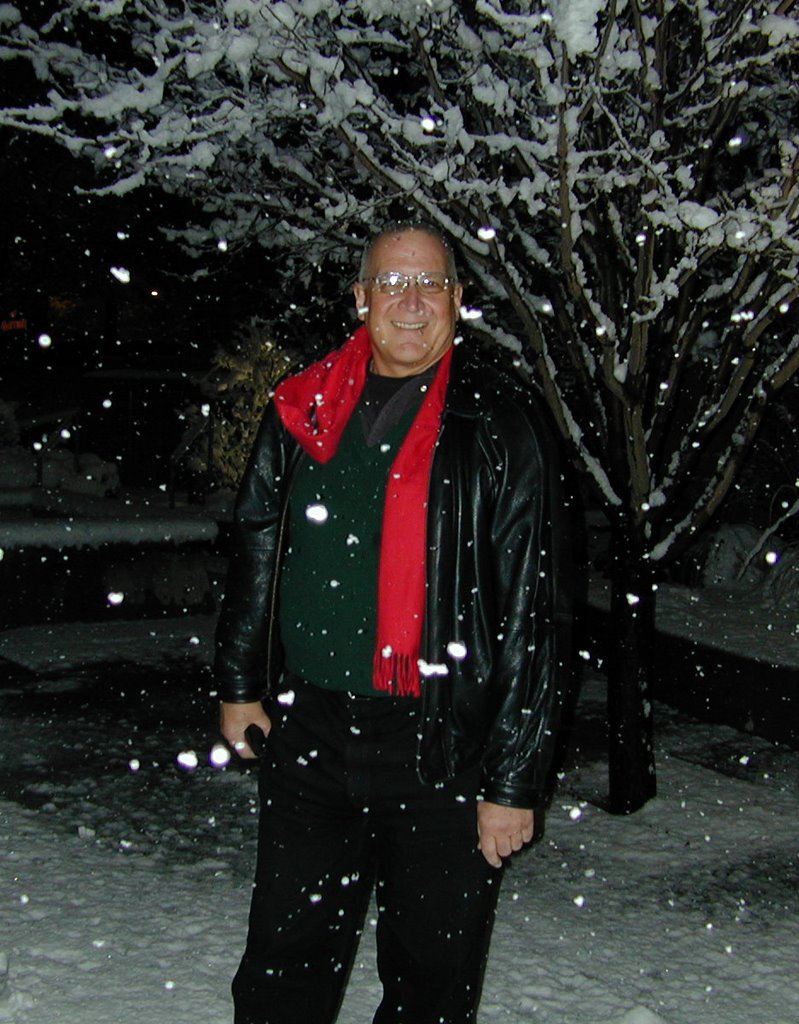
Here is a photo taken by a colleague after work last week, with me standing in front of a snow-dusted tree in the early evening. I am dressed mostly in black and snowflakes swirl all around. The landscape lighting and the flash manage to etch highlights in the dark.

I have, since last April Fool’s Day, been at work on my first novel. My current best guess is that I am at the two-thirds point and eager to finish the homeward journey so I can see the completed first draft in its entirety. Then begins the hard work, for I find the imagining to be play; revising will be another matter altogether.

Though I have never before attempted anything so grand in scale, this is but the flowering of an old seed. When composing some playful tales back in the early 1970s, I conceived of related stories in a larger cycle. The first tale, chronologically, though not in order of imagining, was of a lad who became an epic hero. His deed was the slaying of a demon, a discarnate force of darkness and despair. The outline was in my head, the general course of his hero’s journey discernible on my maps of an alternate world.

And there the tale has remained, ever present in my head but not yet on paper (nor, in more recent times, on disk). Since those early days I have learned more of darkness and depression, not to mention the human condition in general. One would hope that I might learn some things in over three decades!

As a recently ordained assisting priest I came to realize that, as I put it, “everyone is bleeding on the inside.” Whatever our perceptions of others, no matter how “together” they seem—how successful, smart, talented, good-looking, wealthy, powerful, peaceful, charming, and spiritually evolved—they have their own wounds, pains, anxieties, and fears. This unseen hemorrhage is a great leveler and a key to compassion. One need not know the specific pain of another to acknowledge simply that it is there. It is not necessary to open the door of their heart and mind and look within. Trust me, the wound is there.

Once we recognize this, we can more easily set aside envy, resentment, or intimidation in order to behold our fellow sufferer. It is not a matter of “pulling them down” to our miserable level. Actually, I find it ennobling of all. We all suffer, we all try to cope, we all do what we can. Some may do it more elegantly, or more effectively, or more convincingly. But we are, as we affirm so often that it is a cliché, all in this together.

Today I came across a parallel insight. Wee Mama, as she (I assume “she”) identifies herself on Daily Kos, has a tag for her signature line that struck me: “Be very kind, for everyone you know is fighting a great battle.”

This actually takes it a step further. Not only do we all suffer our inner wounds, we all struggle in our own way. Each of us has our own epic battle, the living of our particular life. Each of us is torn constantly between good and evil, most often in the small choices among sundry goods and various evils. It is the decision for the greater good or the lesser evil, and the repeated settling for the lesser good or being swallowed up in the greater evil, that shapes our struggle.

To recognize these truths about each other is to be aware of our common humanity, our limitations, our great failures, and our potential for glory. Once we see this, and realize the truth of it, it is so very much easier to “be very kind.”

How much better our struggles, small and large, might go if we were more kind to ourselves and to one another, if we chose to be allies in each other’s attempt to do right, to do well, to do better.

One of the benefits and dangers of writing fiction is reflecting on what the telling of a tale has told about ourselves. I know that I am in every character and situation and they are all a part of me. (Memories of learning about Gestalt many years ago….) What am I revealing of my own reality or what I wish my reality were when I tell a story of a young man—far younger than I—who has a mystical vision of ultimate light and also, willingly, enters utter darkness?

As midnight approaches and my mind and body weary, I do not propose to answer that question here. Indeed, the question will stay with me through the finishing of the first draft, and the revising, and the pondering when the tale is told.

I wrote on New Year’s Day about “Black on White,” the ebon motion of ravens against a snowy background. Tonight it shifts to light and darkness, hope versus despair.

And so I share the photo: darkness and light everywhere one looks and myself in the middle of the mystery.

“Be very kind, for everyone you know is fighting a great battle.”

(h/t to Wee Mama)
--The BB

Monday, January 01, 2007

Black on White 2007

In a rapid shift from “how silently, how silently the wondrous gift is given” to how noisily we chase away our fears, my year began with me standing outside in a snow-covered world watching fireworks in the street and beating a few of my drums. The neighborhood was not lost in total racket but this was not a time to sleep in peace. Back in California I could never be sure I was not hearing guns fired at the beginning of the year but the only pops in the midnight air last night seemed to be fireworks. (We live in hope.)

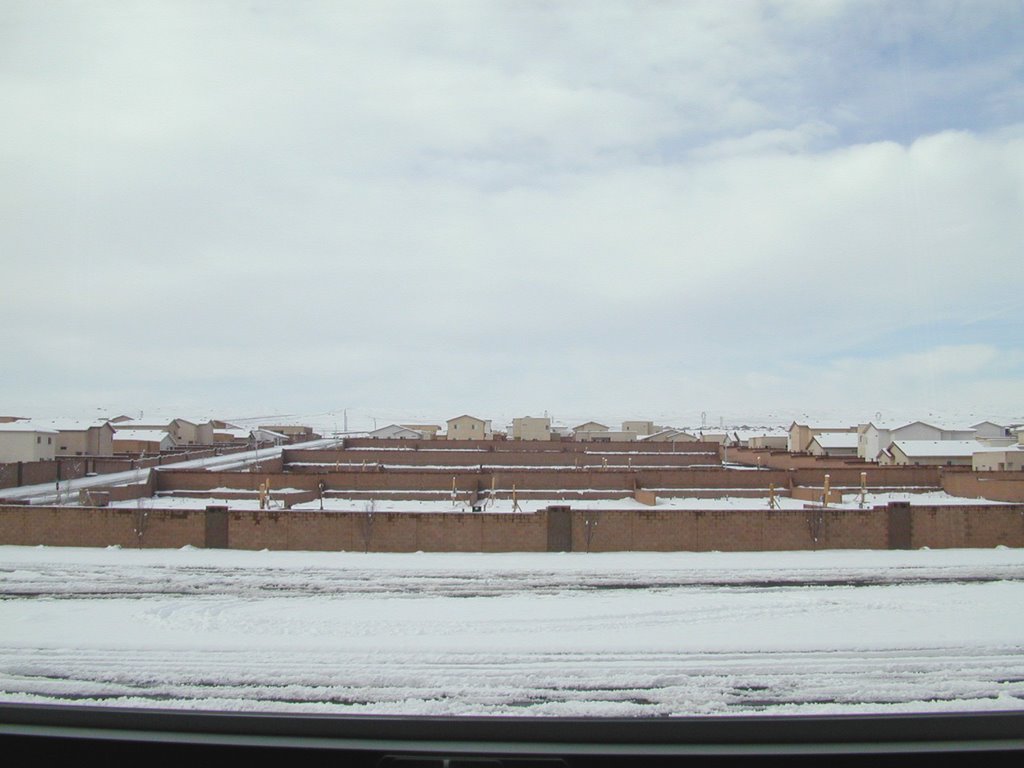
Having chatted earlier with Don Cuervo (not the tequila—never the tequila) about my perpetual mild sleep-deprivation, I allowed myself to sleep in today. When I arose and looked out a bedroom window, the world was still layered in powdery white (not cocaine—never cocaine) and the sun was shining on the construction sites of future homes, and beyond that to new homes not unlike my home, and further west the low rise of the mesa. I spotted a corvid, then another and some more, perhaps a dozen or so in all. Without a close look or a chance to hear their calls, I am rarely certain if I am viewing crows or ravens. Then I noticed two of them in tandem flight. They flew low and wove their way around the masonry walls dividing the lots. One appeared smaller and was usually flying above or only slightly behind the larger. Was it a game, a courtship pattern, or one just mimicking and harassing the other? I have no idea but it was fascinating to behold.

Since ravens delight in aerial acrobatics, I shall assume they were ravens, Don Cuervo’s people, his totem critters—creative tricksters among the ranks of the gods. Let us call it auspicious, the flight of these ebon avians across the snow-covered landscape at the dawn of a new year.

However arbitrary our civil calendar, I wish health, inner peace, and the astonishment of beauty for all. With less fear and more wonder in our lives, may we then blossom and bear the fruits of mutuality and upbuilding of the common good. From that may justice and peace flow like the mighty rivers of Amos’ thundering imperative.

Love yourself this day. Then love someone else.

—The BB

Saturday, November 04, 2006

Don't forget to Vote next Tuesday, November 7

One of the first things I did upon arriving in New Mexico was register to vote. I also have my New Mexico driver's license and just received my first property tax bill. Well, two out of three were exciting!

In addition to absentee ballots, New Mexico also makes provisions for early voting to avoid the rush or meet personal scheduling needs. So I voted two weeks ago. Now I am free to remind others to vote and, possibly, encourage people to vote for a change in Washington, DC.

Many have commented that this may be the most critical vote in our lifetime, and I believe this may be true. I do not believe it is any exaggeration to say our constitutional democracy is under threat from within.

While groups from without can do great damage, such as that wrought on 9/11/2001, I do not fear their destroying the United States. What can undo the grand experiment begun when this nation was formed is the dismantling of the checks and balances written into the Constitution. The founders were very conscious of the threats posed by power concentrated in one person or one small group.

We have seen one political party control both Houses of Congress and the White House, with little restraint from the Supreme Court. Within that framework, a very small group dedicated to (1) expanding the power of the presidency, (2) retaining one-party control, and (3) enriching their cronies has been hard at work undermining any structure, process, or person that would lead to constraint, review, or accountability.

We have watched rights to privacy, habeas corpus, trial, free speech and assembly--all be threatened, diminished, and reduced. We have witnessed the granting of unusual and, I would say, completely unconstitutional power to the executive by the Congress. We have stood by as a wall of secrecy has been built around almost everything the White House does.

All this while efforts to deal with the perpetrators of 9/11 were siphoned off into an unnecessary and illegal invasion and occupation of a country that was not threatening the United States; while concrete steps toward enhancing security were neglected; while incompetence and corruption have not only allowed the excessive destruction seen in Katrina but also done little to deal with the aftermath; as employment and wages have not kept up with population growth and cost of living (especially health care).

We have listened to platitudes about supporting our troops while sending them needlessly into danger without a plan, providing inadequate armor, cutting their pay, and reducing their benefits, then standing by and letting them die or return home maimed and injured, all the while making a bad situation worse without making America or the world any safer. We have listened to sermons about moral values and family values while destabilizing the world, taking advantage of the poor, holding back minimum pay, reducing child care and educational funding, doing nothing about those uninsured, watching health care become increasingly difficult to find or pay for, and seeing the number of families in poverty grow. Ignoring the warnings of Amos, we have seen the gap between the extraordinarily rich and the vast majority increase obscenely. Our government has subsidized the wealthy (e.g., energy companies) while burdening our grandchildren with colossal national debt. Talk about tax cuts has obscured what are really only tax deferrals.

The President behaved as though unconcerned about imminent threats to the nation yet flew back from his vacation "ranch" to sign a bill, of questionable legality, over the unfortunate Terri Schiavo. Instead of following the example of Ronald Reagan who vetoed a critical bill because it had 600 earmarks (pork barrel items) in it, he has passed spending bills with 6,000 earmarks, then vetoed only one bill, and that was one supporting stem cell research. This was supposedly out of respect for life, protecting blastocysts that are almost always destroyed in any case, while callously having no regard for the lives of our troops and the lives of the Iraqi people. He has allowed, and in some cases actively spread, death throughout the world and our nation.

So, if the invasion and occupation of Iraq, the response to disasters such as Katrina, the blowing off of education, the increase of general poverty contrasted with the growth of wealth for the few, rampant corruption (I have not even discussed the K Street lobbyists, sex scandals, outing of a CIA agent, and the environment), secrecy, and violation of basic rights aren't working well for you, vote Democratic this November 7 and send to Washington a Congress that will hold hearings, issue subpoenas, and demand answers and accountability.

Thank you.

The BB

The beauty of Albuquerque

I tend to have a distinctive way of viewing nature. My eye is caught by both vast sweeps of landscape and by small details. This becomes evident when I take walks with my a camera in hand. Since I was working in ABQ at this time a year ago, and at the same place, much of what I enjoy now is revisiting the familiar. I look forward to seeing and exploring new things too. Here are some tidbits.

Leaves filtering sunlight against the autumn sky
The Sandia Mountains viewed from Sun Plaza
I never tire of the trees. The cottonwoods and ashes (alamos y fresnos) are now golden

Friday, September 15, 2006

The Big River Bear

Yes, friends, I have made the move and am now resident in New Mexico, La Tierra Encantada. The California Bear now takes on a new aspect, living as I do near the Rio Grande. So now I am the Big River Bear.

I begin a new job next Monday (hooray!) and for the first few weeks here was busy unpacking and trying to solve the puzzle of what is in which box. Yes, we tried to label well, but life has little glitches. Things are mostly functional.

Have been busy working on The Deed of Ian, a tale that is rapidly taking form as a novel. Over 80,000 words so far and this is only the half-way point. Huge cast and huge territory, a classic hero quest, fictionally based on an epic poem of Mithernesse. Currently into roughly day 38 of the journey. Lots of fun imagining another world, its culture and customs, its spirituality and values. I'm loving it. Revision will be a beeyotch, since the tale almost flows onto the keyboard. Let's just say the first draft is coming along swimmingly.

OK, time for pics. --The BB
The Sandia Mountains

Desert Farne, my new home
Looking south from two blocks away
Eureka, I found gold!

Thursday, July 13, 2006

Experiment in YouTube

I ran across this music video from Iraq, essentially a slide show, through a post by the compiler's mother on dailyKos. My first video post.

Still learning, folks, be patient with me.

The BB

Wednesday, June 14, 2006

How's your BS detector?

If you would like a refresher in basic logic—say, for the sake of dealing with all the distortions and untruths floating around in the political arena these days—then you may find a lovely summary by Liberal Jarhead at Bring it On! I highly recommend it.

Here is one of Jarhead's introductory paragraphs:
There’s nothing wrong with disagreement, and a good debate leaves everyone involved better off for having had to consider other points of view and reassess their own. But for that to be true, the disagreement has to make sense. What I’m talking about here has nothing to do with honest, reasonable debate and everything to do with substituting ugly emotions and closed-mindedness for thought and real argument.


—The BB

Thought I'd disappeared?


A reasonable inference. I have been doing other things than blog of late. Transition is the keyword.

My Monday-to-Friday life has been full of transitions, assisting an office as its functions were split between two entities and two locations, traveling with the smaller portion, and providing continuity and cross-training.

My weekend life has seen me say goodbye to my dearest work in the Bay Area and end a position I had held for 10.5 years.

I have just completed my sixth course at the Graduate Theological Union in Berkeley as part of a postgraduate program.

I have been writing fantasy fiction in the past few months, picking up a thread I laid down 31 years ago. Four full stories are emerging from this and I am at the halfway point in the one that launches the entire series. It has only been in my head for over three decades and is finally coming into text. A huge challenge and great fun.

And on the larger stage, I have celebrated my sixtieth birthday by purchasing a new home in Albuquerque, after a lifetime lived in my native California.

All right, "transitions" is an understatement.

I am excited and have dubbed the sixties as "the decade of adventure." T. S. Eliot said that old men should be explorers.

That's the news in a nutshell.
The BB

Saturday, March 04, 2006

It must be springtime

With the red-breasted robin (Turdus migratorius, or migratory thrush) perched outside, spring must surely be here. I ignore the vernal equinox as the announcer of season because in the San Francisco East Bay more certain signs are the blooming plums and Magnolia tulipifera which blossom by my feast day (Conversion of St Paul, January 25). The robin may be seen through the blinds in this shot I took this morning.

I noted this as several robins have been showing up lately and I do not recall seeing them outside my window in prior years.

Monday, February 27, 2006

Church, State, and Theocracy

I have been posting an essay/extended meditation on the way of Jesus versus the way of Caesar on the church blog for St Cuddy's (St Cuthbert's Episcopal Church, Oakland). Rather than crosspost--because I am a technopeasant and have no idea how to do it--I am simply linking the installments here.

Satan's Throne
Part 1
Part 2
Part 3
Part 4

Part 5
Part 6

Sunday, February 19, 2006

'Shrooms on the lawn

These seem to have popped up in the past couple of days.

Speaking of the last couple of days....
Yesterday a great egret flew by in front of my place, a sight I had never seen from my office window before. I used to see them all the time when I worked next to the Aquatic Park in Berkeley, but not it is rare. They are such beautiful birds. I have no idea how to interpret such a sign but I know I was blessed by it.

The BB

Saturday, February 18, 2006

January 29, 2006, Sunset


Northumbrian Pilgrimage 1997


During the Summer of 1997 I was blessed to spend two weeks in Durham, England, for a seminar on Celtic spirituality and modern mission. We stayed in the Bishop's Castle, which is now a dormitory for University College of the University of Durham. Across the green from us sat Durham Cathedral, site of the shrine of St Cuthbert of Lindisfarne and the tomb of the Venerable Bede. The entire complex has been designated by UNESCO as a World Heritage Site.

We had day trips to Lindisfarne (Holy Island), Hexham Abbey, Wearmouth and Jarrow, Hadrian's Wall, and other sites related to Northumbrian history and the Celtic and Saxon saints who flourished during a rich age of cultural and spiritual cross-fertilization.

The timing of posts related to this extraordinary pilgrimage is related to my having a new scanner and being able to scan the photographs I took back then, along with having a bit of down time to do it. The posts themselves are at the blog for St Cuddy's and I am merely providing links here, but I wanted friends of the Byzigenous Buddhapalian to have easy access to them.

May blessings from the Creator abound in your lives and the prayers of St Cuddy support you.

The BB

Lindisfarne / Holy Island


Lindisfarne Priory-Part 1

Lindisfarne Priory-Part 2

Hobthrush Island

Lindisfarne & Durham Architecture-Part 1

Lindisfarne & Durham Architecture-Part 2

St Mary's Parish Church-Lindisfarne

Lindisfarne / St Mary's

The Chi Rho Page of the Lindisfarne Gospels

St Cuthbert foretells a death

Cuthbert becomes a bishop

I will update this if and when I have some more. Happy journeying to all weblog pilgrims!

Friday, February 17, 2006

The Retrograde Metronome

Gnus and views
and baby Kangaroos;
Fillets and skillets
and soldiers in very odd billets.

There once was a bearsy named Boris
Who questioned a tree in the forest,
"Can a teddy bear fly?"
"We don't know, silly guy,"
Replied the required Greek chorus.

As the rain still continued to drizzle
And the bull dribble piss from his pizzle,
The wind softly soughed
As the cannon was stuffed,
But when lit, all the fuse did was fizzle.

With that we conclude today's intro
Thought we're not really sure what we meant, so
We will quit while ahead
As the ungrateful dead
Haunt the vacuous spaces al dentro.

You've been great! Thank you all! Good night!

PES
18 February 2006


Well, I just thought my whimsy output had been way too low of late and this bubbled up while sending an e-mail to a friend.