Saturday, October 11, 2014

Sulla strada dell’esilio


Paris Night

Upon the stonework bridge I stood
   with shoulders bent and head
And listened to the songs of night
   sung by the river below
And the clouds above which veiled
   the winter moon, so far
From what I once called home
   yet farther still from all I'd dreamed.

A shadow in the alleys of the heart
   wandering in fear and hope
Surrounded by the memories of now
   and then and tomorrow
Squeezed into a moment caught between
   the massive centuries
Yet living in that moment all
   unuttered human drama

Now sensing in my soul that night
   forever there yet gone
I know of many waters fled
   beneath the bridge of stone
And much to flow.  I await
   the ultimate union
Of river and sea, of sky and earth,
   reality and dream.

Cum subit illius tristissima noctis imago,
Qua mihi supremum tempus in urbe fuit,
Cum repeto noctem, qua tot mihi cara reliqui,
Labitur ex oculis nunc quoque gutta meis.

20 mai 1968

The closing quatrain is Ovid, Tristia 1.3, in which he laments his exile from Rome.  One translation is as follows:

When the saddest memory comes to mind,
of that night, my last hour in the city,
when I recall that night when I left so much
so dear to me, even now tears fall from my eyes.

The photo shown here was taken in May 2014.  I am sure the view was less brightly lit when I stood in the same spot in December 1967, a young student far from his native California yet who felt so at home in this great and beautiful European capital.

This is one of the items buried amid chaotic gibberish in the journals of my college and seminary days.  Evidently written just before my college graduation it speaks of the memories and yearnings awakened during my semester abroad.  The "many waters fled" suggest the immense changes I felt within from my time in France, experiencing a different culture, thinking and even dreaming in a different language,  learning to eat and dress and behave somewhat differently from the ways of home.  Memories "squeezed into a moment caught between the massive centuries" even today makes me think of the exterior reality of walking down streets with stone walls on either side, ancient walls (especially to someone whose entire life had been lived on the West Coast).  In fact, I walked each day past Notre Dame de Paris going to and from my hotel.  And here was my little life caught in that immense context, and feeling that I was very much part of it while simultaneously a stranger in its midst.

Well, let us assume a kid who cites Ovid in Latin must have some feeling for centuries of history.

Exile, journey, and longing for a home still unknown are undoubtedly themes of my life and now that I am in my late sixties it is certainly time to reweave these threads into some deeper wholeness.  The Italian title ("on the road of exile") comes from Turandot, possibly my favorite passage in the opera:

LIÙ (si avvicina al Principe, piangendo)
Signore, ascolta! Ah, signore, ascolta!
Liù non regge più!
Si spezza il cuor!
Ahimè, ahimè, quanto cammino
col tuo nome nell’anima,
col nome tuo sulle labbra!
Ma se il tuo destino
doman sarà deciso,
noi morrem sulla strada dell’esilio!
Ei perderà suo figlio...
io...l’ombra d’un sorriso!
Liù non regge più!
Ah, pietà!

IL PRINCIPE IGNOTO
Non piangere, Liù!
Se in un lontano giorno
io t’ho sorriso,
per quel sorriso,
dolce mia fanciulla,
m’ascolta: il tuo signore
sarà domani forse solo al mondo...
Non lo lasciare,
portalo via con te!

LIÙ
Noi morrem sulla strada dell’esilio!

TIMUR
Noi morrem!

IL PRINCIPE IGNOTO
Dell’esilio addolcisci a lui le strade!
Questo, questo, o mia povera Liù,
al tuo piccolo cuore che non cade
chiede colui che non sorride più...
che non sorride più!


***

LIÙ (weeping, approaches the Prince)
My lord, listen, ah! listen!
Liù can bear it no more!
My heart is breaking!
Alas, how long have I travelled
with your name in my soul,
your name on my lips!
But if your Fate
is decided tomorrow
we’ll die on the road to exile!
He will lose his son...
And I...the shadow of a smile!
Liù can bear it no more!
Ah, have pity!

THE UNKNOWN PRINCE
Don’t weep, Liù
If one far-off day,
I smiled at you,
then for that smile,
my sweet girl,
listen to me: your master tomorrow
will be perhaps alone in the world...
Don’t leave him!
Take him away with you!

LIÙ
We’ll die on the road to exile!

TIMUR
We’ll die!

THE UNKNOWN PRINCE
Soften for him the road to exile!
O my poor Liù, this, this
is what he who smiles no more
asks of your unfailing heart...
he who smiles no more!

Darkslayer, books one and two of The Chronicles of Mídhris, tells of my young hero Ian Dyrnedon who slips between dimensions and finds himself in a parallel world.  He never returns to his family in Yorkshire and is forced to make his home in a new world and among a new people. There he finds such happiness and peace as he can, though life forces upon him so many and such strong experiences that there is always a restlessness, a source of perpetual uneasiness for his wife, a strong woman whose sole weakness is concern for him.

Books three through eight have similar threads in the story lines and the final two volumes (should I live long enough to get them written) bring the story of the redactor of the Chronicles, my own alter ego, who suffers an ultimate parting no words can capture.

I suppose the two clearest life tasks I now face are making sense of the journey of my life and getting the story of the Dyrnedon family journey into published (or publishable) narrative.  Whether any other huge tasks will come to pass remains to be seen, and I am agnostic there.  That I leave to Christian grace and Eghran's chance.


--the BB

Thursday, October 09, 2014

Ho i miei libri


I have my books
And my poetry to protect me;
I am shielded in my armor,
Hiding in my room, safe within my womb.
I touch no one and no one touches me.
I am a rock,
I am an island.

And a rock feels no pain;
And an island never cries. 
--Paul Simon

 
I was a huge fan of Simon and Garfunkel.  Their first album, Wednesday Morning, 3 AM, was released on October 19, 1964.  I started college in fall 1964.  Going back to those songs is total nostalgia for me.  A wistful alienation, so common in that era, spoke to me.  They were overshadowed by the Beatles but I much preferred Paul and Artie.

There is no question that I saw the tragic sadness of anyone so cut off from others as the narrator of "I am a rock," and I did not hold that as any kind of ideal.  I admired the skill with which Paul Simon's words and music captured this kind of isolation, a shielding from the hurt that others can inflict, a defense against vulnerability, love, loss, betrayal, doubt, etc.

Tonight I listen to this song and look at these lyrics and think, "OMFG, that is truly who I was when I first fled my home town to the exotic environs of Claremont, California."  From the perspective of maturity I can look back and see exactly how deeply armored I was (and have been).  The added resonance of the moment lies in my current project, returning to the books of my youth to relive my journey, only this time without so many defenses.

I confessed in an earlier post that I have seen trees as guardian spirits: friendly, safe, watching over me.  I have often preferred trees to people. With trees I have never been pressured to perform, to be something I am not.  I am safe with trees.  Extending the imagery a bit, from trees we make books.  If trees represent the external (non-human) world in which I feel safe and which exalts my soul, then books represent the internal world in which I feel safe, the world of my mind and imagination, the meeting ground of souls across time and space where ideas and emotions are shared... but at a remove. A book or an idea may make some claim on me, demand some response, but there is not a physical person facing me: the situation where I immediately start to gauge "what does this person want from me?" and start to shape myself to that intuited, projected, genuine, or utterly misread desire of the other.  In short, when I am with other people my knee-jerk response is to abandon my self-hood in order to respond to them or elicit a response from them.

When one has done that for almost seven decades it is difficult to stop.

There is an element of shock in finding myself musing on this tonight.  As I seek to break out of the ancient patterns that initially allowed me to survive but then crippled me across the years, here I am going into one of my greatest retreats: books and the inner world of my mind.  Then again, the way we find healing of our past wounds is by naming them and dealing with them, often reliving our past, seeing if from new perspectives, letting ourselves grieve (with all the steps of denial and anger and bargaining, etc.), and eventually coming to peace.  We can acknowledge our very personal truth, honor both the good and the bad, keep what is of value, let go of the rest, and move forward.

So I retreat once more, but this time quite consciously and with the guidance of a good shrink, with a heart full of hope, and with friends who graciously put up with and support me in this journey.  I go within in order more freely and honestly to open up and open out.  As Hestia helps me to guard the hearth fire of my heart, the security of the inner flame can allow me to open more doors and windows and not hide a terrified spark behind so many barriers.

Beginning with my college years I kept journals.  I think I had thirteen notebooks eventually and only a few years ago tossed almost all of them.  I thought I could walk into my library right now and pull out the first one, started in my freshman year--contemporaneous to my early listening to Simon and Garfunkel. What I laid my hand on was volume two, spanning from July 1970 through January 1976.  Now this is going to be interesting reading!  Here is an early snippet, selected for the obvious link to the theme of Odyssey.

15 novembre 1970
"Odyssey"
Always going forth hoping to find
eternal journeys toward the evening
and the unknown - my own odyssey -
endless descriptions beyond the door
which marks my beginnings and measures the rhythms
of missed returns.  And so I wonder,
as I start my search just once again,
if destinations lurk beyond
the shadows of night, and if I might
perhaps this time be able to pierce
the curtain which cuts my dawn from my dusk,
airwoven mistwebs tangled in branches,
memories caught in my moments to snare me.
Then the mingled fires might greet me,
sunset, lamp, and hearth together,
waiting for my weary footfall
coming up the steps and crossing though
the door at last and knowing I was
home.

[Below that is written: "That's a lousy vehicle for two lines."  I have no idea now which two lines.]

 I am tempted to comment: "Holy fucking shit! The conclusion of that poem is basically the ending of Darkslayer, Volume Two."

The thing is, of course, that my books and my poetry do not protect me.  Yes, they give me a safe space to ponder but they also pierce me to the depths, nourish me, challenge me, and remind me of truths deeper than words.  And, even if only in private, they have kept me vulnerable.  Rather like the desert monastics in the third and fourth century who fled to the Egyptian desert and there, in such incredible isolation, united their beings to the cosmos and to God, facing within themselves all the life-and-death struggles of the society they seemingly left behind.

So my current plunge into classic texts seems, to me, anything but safe.  I am off on the hero quest. There will be monsters.  Whether I need to slay them or befriend them or both or neither remains to be seen.  There is no formula, no rulebook, no guarantee. As my friend Lee shares in the old proverb:
Caminante, no hay camino; el camino se hace caminando.
[Traveler, there is no path; it is made as you go.]
 

 I also want to add that in the past few days some pains that I have admitted with my head but had immense difficulty feeling in my heart and gut now seem to be surfacing and I give great thanks for this.

--the BB

Wednesday, October 08, 2014

Chi non ama

My current odyssey involves looking into my distant past and all my journey since, seeking the threads woven into the fabric of my life, the connections, the clues, the glorious adventures and disastrous wrong turns--and making some kind of sense of it.  I did not type "find some kind of sense" but "make some kind of sense."  The extremely rational part of me that views the universe as a complex marvel of quantum mechanics considers everything to be a dance between Randomness and Pattern.  Randomness means we mostly waste our time asking about purpose but that does not deny meaning.  We create meaning as we tell our stories, giving shape to events.

Rephrasing this somewhat: Does everything happen for a purpose?  I do not believe so. Most stuff just happens.  To believe everything happens for a purpose implies that there is a force controlling everything (goodbye free will) and that this force purposes all sorts of disaster and meaningless suffering.  I cannot buy that. Hello, Theodicy 101. Which is background for this essay, though not truly its central issue.

Anyone who knows me is well aware that I have a questioning mind.  In fact, even more questioning than appears on the surface because a lot of skepticism, evaluation, doubt, and testing is going on in the background that I don't even bother to discuss.  I did not make life easy for my teachers.  I even uttered "bullshit" during a class in seminary.  Yes, aloud.

And what about the role of faith?  Ah, any survey of my life journey would find mountains of material around faith.  Yes, there are things I accept as basic, regardless of any lack of empirical proof and sometimes in the face of contrary evidence.  But that body of faith assertions is very limited and has grown smaller over time.

I have always had a problem with "faith" being invoked to short-circuit rational inquiry, to dodge contradiction and inconsistency, and to bully people into silence and unthinking obedience.  And the evidence for that kind of "faith" (invoked as a weapon) is vast and overwhelming.  I grew up with it.  I spent my summers surrounded by Fundamentalists (I capitalize the word to insist on its original historical context among a subset of conservative evangelical Protestants).  I did not. Fit. In.  I am quite aware that I will be reacting against religious fundamentalism to the day I die.  If my rants against it are problematic for you, feel free to skip most of my posts because my abiding pain and anger do not incline me to go gently.  I do hold such preachers and teachers and organizations responsible for much that is wrong with the United States today and for the anguish, fear, and anger they infuse into their listeners.  If I believed in purging people from society, which I do not, that is where I would begin: pastors.  Yes, I know.  I am a clergyman. Why do you think I know this shit from the inside?


Image from Wikipedia, released to public domain

The heart of stubborn adamant
unyielding would resist
the twists and turns, bullshit and cant
that others would insist
must have assent, must be believed,
set limits to the mind.
That tender, rocky heart was grieved.
It knew the Truth was Kind.

That is a piece of doggerel I composed last night.  I do not offer it as I do poems of which I am proud but as something that captures part of my truth.

Part of my challenge in relating to other people has been the defense I developed early on in order to resist the pressure from without to conform: to say things I did not believe, do things that made me uncomfortable, not do things that gave me joy, deny my feelings and my needs, and attempt to be someone other than myself.  Yes, as a clever, white, middle-class, Protestant male in post-WWII America I had incredible privilege denied to those who started life without those unearned advantages.  Yet even in that privileged context there were messages, constant messages, that there were things wrong with me. When you look simply at sexual orientation, this means who I am is wrong, not just what I believe or say or feel or want.

To live with that judgment, always unspoken but sometimes shouted from pulpits, can lead to a crushed soul.  To many it opens the door to despair and suicide.  That was not my temptation.  But in order to survive I kept a spark within me buried so deep even I could rarely remember it existed.  It was protected by granite, adamant, and steel.  I should not be surprised if a cherub or two also watched over it with a flaming sword (thanks, angels, by the way).  My soul was protected because it was locked in a prison.  You were a rare soul, indeed, if I ever invited you past the first few gates (and they were countless).

I could appear expressive, in touch with my feelings, outspoken, etc. but that is because the surface persona was as free as the deep self was tightly bound and hidden. Performance.  We introverts perform a lot when around people.  Now that I am trying to be authentic it requires immense shifts in my perceptions and behavior.  No small task.

So here this introvert is sharing these deeply private musings publicly on the internet.  Bizarre, yes?  It is easier to open up at a distance.  I am not watching your face for clues, dear reader, that might shape what I say.  Instead I attempt to speak my truth and you may make of it what you will.  I need allies to share this journey with and I hope at least some of my real life friends in what some call "the meat world" will read and engage what I write here.  I hope they will be gentle. As strong as I feel these days, and ready for change, this remains scary stuff.

One of the most immense shifts of this past year is that I have ceased attending church.  There was a time as a devout Catholic (not Roman, just Catholic) Christian I missed being fed if I did not attend Eucharist and receive Communion every week. (Yes, I was a lousy Protestant; way too mystical and sacramental, and Protestants don't even speak those languages.)  I do not miss it now.  My life is lived in the world, out with the tax collectors and prostitutes and sinners and drunkards that Jesus hung out with, if you will.  Most church language sounds meaningless to most people and I just cannot try to speak it any longer.  If I still believe in Good News (and I do), then I must share it in ways that make sense and that is mostly by the way I am with other people.

I am rather agnostic on all matters metaphysical.  As a language major I view all expression as metaphor.  The word is never the reality we try to communicate, it is a symbol, usually at several levels of abstraction.  No word can capture any reality, much less a transcendent one. This does not relieve us of the the task of communication.  My personal, mystical experience of the Ultimate calls for some response from me.  The language I use may all be symbolic but that is all right.  For me it is the language of Love.

There is incredible comfort between me and my atheist, agnostic, and pagan friends, not to mention folks of many faith traditions.  I feel no compulsion for them to believe any set of doctrine.  I want them to experience love and to rejoice in it.  As I said to a friend years ago, "I am not troubled that you no longer believe in God.  I believe that God believes in you and that is enough for me."

I would like to be clear that when I defend my right to my own selfhood, feelings, thoughts, and needs I am not rejecting our relationship to society and the larger whole or denying responsibility toward that context. But I am defending us all against mindless conformity.

All those decades when I feared causing trouble for family or church by expressing who I am and what I feel and think....  And the trouble I have gotten into when I expressed myself freely.... All I can say is: Fuck that noise!

This blog is my blog for my musing and my sharing.  I have some really rude words for those who got their knickers in a twist when I was trying to serve the church for nothing more than the satisfaction of being faithful, but I won't kick up that dust today.  It is nice to be retired from church. I simply can no longer fight the fight against meanness, willful ignorance, and hatred in the name of Christ--and I do NOT speak of the congregations where I served or the dioceses to which they belong, but to that vast, heretical, hateful phenomenon most Americans witness as Christianity. Where people worship God, love each other, and serve their communities they have my unqualified blessing.  Where communities try to straight jacket though and behavior, they have my hearty curse. 

Do I still believe anything?  Actually, yes.

Chi non ama non ha conosciuto Dio, perché Dio è amore.


As the Rabbis Hillel and Jesus said: Love God.  Love neighbor.  Love self.  The rest is commentary.

--the BB

Saturday, October 04, 2014

E piangevo

This post has links to my current reading, to things I have stumbled across on the web by chance and things I encountered while searching for something different.  It involves some of my deepest pains and passions.  It is about yesterday, today, and always.


Rembrandt's Prodigal Son
Hermitage Museum, St Petersburg
This photo was just taken in my hallway 
where a print I bought at the Hermitage hangs.

I want to begin with the most striking take on the familiar parable of the prodigal son that I have ever encountered.  The story comes from commentary on a current crisis in a seminary, but that is not part of my story today.

[The commenter] was once doing a bible study on the Prodigal Son, asking each member to share with whom they identified -- the older son, the younger son, or the father, and why.  One person had not shared, so [I] invited her to speak. "No," she said, "what I have to say is stupid."  [I] assured her that it was not, and her reflections were as valid as anyone else.  "I identify with the Fatted Calf," she said.  "Think about it:  the Fatted Calf is the only one in the story that didn't do anything.  The younger son ran off, the older son was resentful, the father gets to be the good guy.  The fatted calf was happily eating his slop one day, next thing you know, he's dead.  He suffers because of the decisions others have made."  
 It seems that most humans throughout history are in the situation of the fatted calf, suffering poverty or war or oppression because of the decisions of others.  I just finished reading the opening argument between Agamemnon and Achilles in the Iliad. Each of them gets his fee-fees hurt, as we now say of big bad persons whose delicate feelings are disturbed and then proceed to make a huge stink about it. For that the Trojan War is prolonged and many die horrible deaths.  For that matter, the entire story of the Trojan War traces back to bruised feelings.  Eris is not invited to a feast, a golden apple sets  up rivalry, and then all hell breaks loose.

But Achilleus weeping went and sat in sorrow apart from his companions beside the beach of the gray sea looking out on the infinite water. (Iliad I.348-350, tr. Richmond Lattimore)
He had been publicly humiliated, though he gave as good as he got when it comes to insults.  So more death ensues, including death of comrades.

Whenever we read of mighty deeds by glorious heroes there is usually an ineluctable consequence: death.  Who pauses to think of the "common" person, the innocent victim, the collateral damage?  Do U.S. drones protect us in any lasting sense or merely sow the seeds of future terrorism, a harvest that must one day be reaped?  For any talk of surgical strikes we know there is no such precision.  People die for the decisions of others, by instruments guided from the other side of the world.  And the decisions of others, throughout human history, are not always rational but rather driven by our deep passions and dark anxieties.


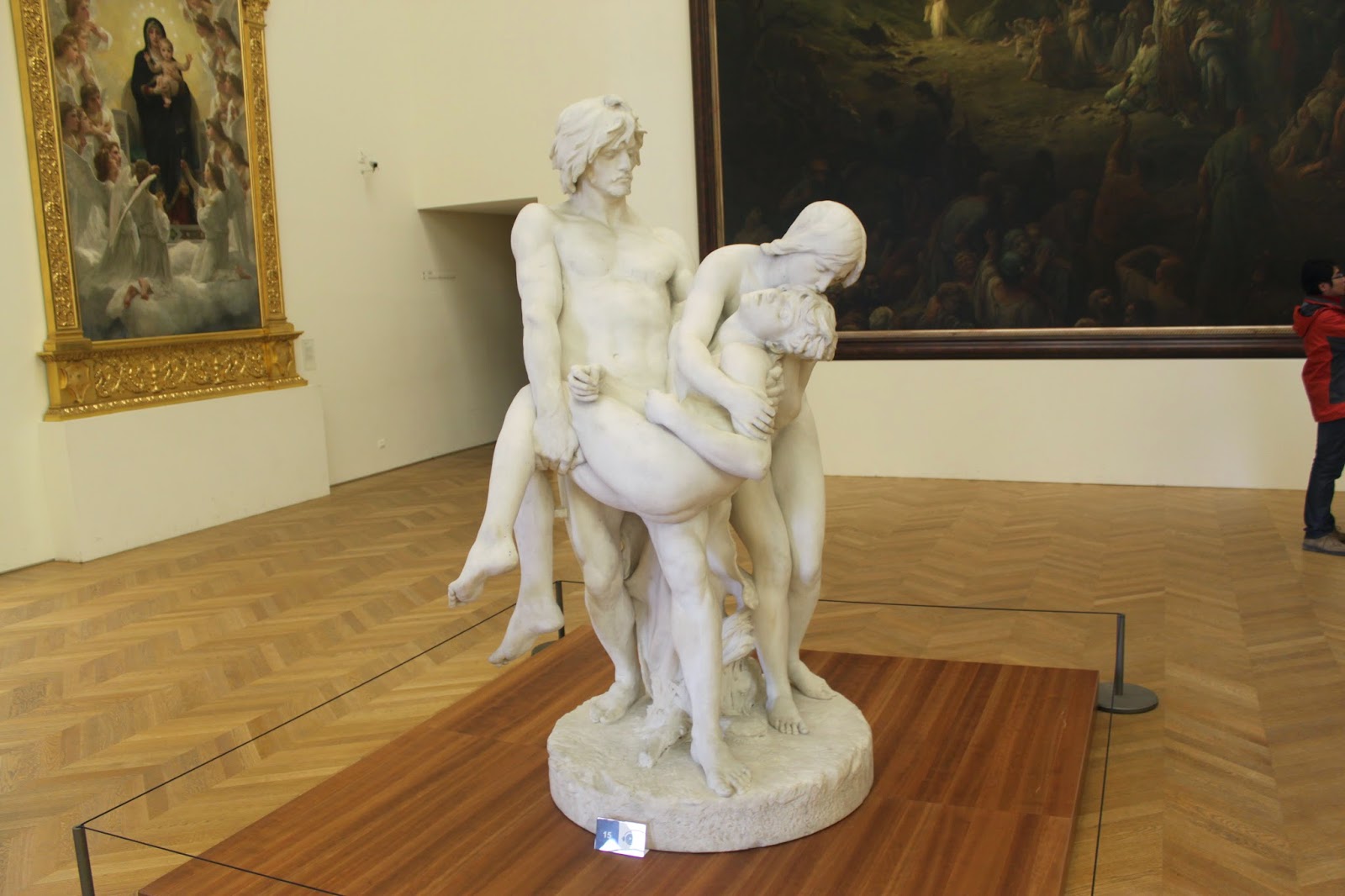
"The First Funeral" in the Petit Palais, Paris.  I took this photo in 2012.  Adam and Eve first taste death in the loss of their son Abel, victim of his brother's envy.


Almost a century ago the world witnessed, though some of it still denies, the Armenian genocide.  I grew up among survivors and their descendants.


Genocide in Darfur, South Sudan.


The Holocaust under Hitler.  And I lived among survivors and descendants of this genocide.


The Killing Fields of Cambodia under Pol Pot.  I also worshiped and ministered among survivors of this genocide and their descendants.


Kosovo, 1999.


The muddy fields of Passchendaele, WWI.


Rwanda, the genocide we all ignored.

Perhaps it is easier to step back from the mass horrors, they are so overwhelming.  Yet even one human lost because of the passions of others remains tragic.  I posted a while back about how this sculpture touched me as I was becoming sexually aware but continues to move me deeply as it captures the dying moments of a warrior far from home. And what of the wounded warriors who return but cannot leave the battle behind them?  Ever.


The Dying Gaul, Palazzo Nuovo, Campidoglio, Rome

But if we move to the particular we find ourselves facing the individual, the personal, the familiar: people we know or have known.  These are the loved ones, the relatives and friends, the friends of friends, the neighbors, the men and women we see in our communities or transiting through airports. We know some of their stories.  Or, more likely, we will never know because they are unable to tell them. What has been called shell shock or battle fatigue is now named post traumatic stress disorder, or PTSD.

What deadly sacrifices do we insist on making, generation after generation?

I had to scroll back quite a bit to see where I posted this on Facebook:
Think / Neither fear nor courage saves us. Unnatural vices / Are fatherred by our heroism. Virtues / Are forced upon us by our impudent crimes.
--T. S. Eliot, Gerontion (1920)
In spite of all I am writing here, I do believe in a true heroism.  This is seen in sacrificial action in the face of, not the denial of, fear.  I believe most heroes are those who do the kind and generous and true and noble thing in everyday life, even when it costs them in time, effort, anguish, pain, and doubt.  Especially in moments where there are no easy answers.

But then there are the dark demons that tell us we are doing something noble, important, and worthwhile.  And we sacrifice to those demons.  Not only ourselves but we sacrifice others.

Rembrandt again: The Sacrifice of Isaac


Akedah
To all the sons not rescued by a ram,
To father’s gods and demons sacrificed,
Whose bonds were never mercifully sliced
And thus became themselves the offered lamb:
This mount was surely never sacred ground;
Just one more evil spot upon the earth
Where death could reign instead of joyous birth
And witnesses were deaf to victim’s sound.
The Lord did not provide.  You bore the flame
Of your own holocaust and hauled the wood.
You both assembled stones and then you stood
And wondered what would happen.  Then it came:
The moment when all filial trust was broken
And you, yourself, became the demon’s token.

Paul E. Strid
20 March 2014
Not all the stories have a happy ending.  I have no problem saying I do not believe in any deity that would make the demand narrated in Genesis 22.  It is too horrible a story, though it is also far too true in human history.  I believe in a God who never needs, and never required, to have honor satisfied or arbitrary justice fulfilled, to demand sacrifice to be placated, or to see the blood of Jesus to make everything all right. That God in Christ bled and died to satisfy our blood lust: that I grasp all too well.  I was raised on the most awful atonement theology and a sadistic streak runs through it, speaking of our own need for something terrible.  It has troubled me all my life and I gradually came to reject it and I totally renounce it.


And so we join Rachel, weeping for her children. She is another Eve from The First Funeral, only now her children are more numerous and senseless slaughter has multiplied.  She is the Sorrowful Mother.

I do not know the ultimate source of the words that follow.  I came across them on tumblr.


e piangevo, perchè sapevo che l’avrei sempre avuta dentro, quella tristezza che mi fa sentire vuota, che non si può speigare

[and I wept, because I knew I would always have within me this sadness that makes me feel empty, that I cannot explain]


This is a crucifix attributed to Michelangelo in the Basilica of the Holy Spirit, Florence.  It is the bookmark I am using as I read the Iliad.  It keeps me mindful of the cost of our passions.

Jesus Christ the same yesterday, and to day, and for ever. --Hebrews 13.8
Just as suffering and slaughter as a result of the decisions of others is the same yesterday, and to day, and for ever.


--the BB

Thursday, October 02, 2014

Torpore e rimpianto

The shade of Tiresias, consulted by Ulysses in the underworld


In English 101 we read T. S. Eliot's The Waste Land.  It seems an incredibly undisciplined poem, roaming all over the place as though Eliot could not rein in his love of words and how they sound, heaped upon each other, with allusions going in all directions.  It is a veritable tour through mythology and imagery.  Vegetation deities and the Paschal mystery, the two already hardly unacquainted, and the history of European literature all seem to bounce about.  Well, as a lover of words and images and mythology I could only fall in love with it.

As Barbara Kaiser and I walked toward our English class with Dr. Barnes on the day this poem was to be discussed, we had a chat.  I do not recall who initiated it but I do remember we always called each other Miss Kaiser and Mr. Strid, mimicking in reverse the way all professors at the school were addressed with no "Doctor" thrown in. Whichever of us began, it ran something like this:
Well, Miss Kaiser, what did you think of The Waste Land?
I hated it, Mr. Strid.
Really?  Why?
I couldn't understand a word of it.  Could you?
No, but I loved it.
How can you love it if it makes no sense to you?
It doesn't have to.  I just loved the words and the way they sound.

This may be a poor approximation of the words, but I assure you it was the content.  I have read and reread the poem many times, savoring Eliot's notes.  I loved that it incorporated fragments of so many other works (and in several languages).  My polyglot mind must have danced.  A couple classmates and I even recorded our own dramatic reading (reel-to-reel tape, children).  Many years later I ran across Jessie Weston's From Romance to Ritual, which inspired the work, and read that plus rereading Eliot, with a deck of Tarot cards at hand as well.  I have read it dozens of times, I suppose, and also came to love The Four Quartets by Eliot.  But they were the subject of a series of musings on this blog some time back.

Some segments of The Waste Land delighted me with their wit and invention.  Some amused me highly.  The poet knows how to do the most literate snark.  Some passages invite prolonged reflection.  Occasionally I am overwhelmed by the imagery, just as one can be overwhelmed by the perfumes in section two on "A Game of Chess."  Some phrases stir up some deep shit bred of memory and desire.  And then there are scenes that touch some barely perceptible chord deep within, evoking a stirring, perhaps a touch of disquiet or tender sympathy.  I believe disquiet and sympathy lie behind this post.

Here is the scene that triggers my musings:

At the violet hour, when the eyes and back
 215
Turn upward from the desk, when the human engine waits

Like a taxi throbbing waiting,

I Tiresias, though blind, throbbing between two lives,

Old man with wrinkled female breasts, can see

At the violet hour, the evening hour that strives
 220
Homeward, and brings the sailor home from sea,

The typist home at tea-time, clears her breakfast, lights

Her stove, and lays out food in tins.

Out of the window perilously spread

Her drying combinations touched by the sun’s last rays,
 225
On the divan are piled (at night her bed)

Stockings, slippers, camisoles, and stays.

I Tiresias, old man with wrinkled dugs

Perceived the scene, and foretold the rest—

I too awaited the expected guest.
 230
He, the young man carbuncular, arrives,

A small house-agent’s clerk, with one bold stare,

One of the low on whom assurance sits

As a silk hat on a Bradford millionaire.

The time is now propitious, as he guesses,
 235
The meal is ended, she is bored and tired,

Endeavours to engage her in caresses

Which still are unreproved, if undesired.

Flushed and decided, he assaults at once;

Exploring hands encounter no defence;
 240
His vanity requires no response,

And makes a welcome of indifference.

(And I Tiresias have foresuffered all

Enacted on this same divan or bed;

I who have sat by Thebes below the wall
 245
And walked among the lowest of the dead.)

Bestows one final patronizing kiss,

And gropes his way, finding the stairs unlit…


She turns and looks a moment in the glass,

Hardly aware of her departed lover;
 250
Her brain allows one half-formed thought to pass:

“Well now that’s done: and I’m glad it’s over.”

When lovely woman stoops to folly and

Paces about her room again, alone,

She smoothes her hair with automatic hand,
 255
And puts a record on the gramophone.
 It is a tawdry vignette of two people doing what lost and lonely people do.  When I read it as a freshman I was, no doubt, initially tittered, then troubled, amused, and saddened.  I find it disturbing, far more now than back when I was a frustrated virgin.  Before I add my personal reactions I want to
add what Eliot says in his notes to the poem:

Tiresias, although a mere spectator and not indeed a “character,” is yet the most important personage in the poem, uniting all the rest. Just as the one-eyed merchant, seller of currants, melts into the Phoenician Sailor, and the latter is not wholly distinct from Ferdinand Prince of Naples, so all the women are one woman, and the two sexes meet in Tiresias. What Tiresias sees, in fact, is the substance of the poem. 

Tiresias, the blind seer, is mentioned in Ovid's Metamorphoses as having struck two coupling snakes and been turned into a woman for seven years.  When he sees coupling snakes again he strikes them and is turned back into a man.  As one who has "seen both sides" he was called upon to settle a dispute between Jupiter and Juno over which sex gets the most pleasure out of lovemaking.  That is background; you can read his verdict and its consequences on your own.

As a gay man I can experience the delights of both pitching and catching, so there is a certain identification with Tiresias, though I have never wanted to be anything but a male.  Role confusion I may have known in a society of rigid expectations but never gender confusion.  Still, I can identify with both the man and the woman in the scene cited above.  Like any male I am patterned by biological evolution and societal encouragement to take advantage of opportunity where it presents itself.  When I was young and pimply I could barely recognize opportunity when it came knocking and I was too terrified to take advantage of it (I believe there was one chance in high school that haunts me still) or, well, too icked out at the thought of doing anything beyond a hug with a female.

The woman here, however, captures a theme I have already raised in this extended biographical pondering.  I have lived a life with weak, often non-existent, boundaries.  I would give without even being asked.  What I gave was my own selfhood.  In order to survive I have always kept a core locked away and inviolable and if any reader has ever had trouble connecting with me, now you know why.  Like the typist, I have endlessly been in situations where others and their ideas, intentions, and actions have been, by me, unreproved even when undesired.  I have gone along, said "yes," felt used and resentful, violated, and almost never uttered a word of resistance or reproach.  the most profound alienation existed between that with which I went along and what I felt inside.

Gradually, and very late in the game, I am getting better at (1) being myself, (2) standing up for myself, (3) speaking my truth, and (4) clarifying and defending my boundaries.  This latter is quite different from the defenses of the past, the great walls and moats, deep dungeons bound with adamant and steel.  Those preserved the endangered sparks of my threatened self, threatened because I had not learned to be strong in who I am.  True, I have the stubbornness of a Taurus, and can dig in my heels when I feel manipulated but mostly I just practiced passive aggression.  I could not be clear and communicate honestly; I simply refused to give others what they wanted.  The mere fact that these current writings are posted publicly, where friends, family, and strangers may read, is an indication that the deep dungeon door, so long defended, has inched open.

Today I feel no need to rage about this.  Well, not at the moment anyway. I have lots of grieving to do and anger still to process.  But mostly it is sadness.  I reread this passage from Eliot last night and tonight I want to weep because for me it captures so much waste, so much unhealthy relatedness, so many lost opportunities, so many moments of regret and the ensuing numbness to avoid facing what has happened. Hence the title of this post: numbness and regret.

Memory and desire.  Numbness and regret.  Living our lives as lies.  Torpore e rimpianto.

If only to get this far, I think this literary revisitation is proving profitable.

My shrink is on retreat.  When he returns we are going to have a lot to talk about.

--the BB

Wednesday, October 01, 2014

Il paese dei sogni

The old neighborhood

The last post commented as follows:
When I left California at age 60 it was to begin again and find myself, having lost myself in so many directions. 
This may have been one of the greatest understatements, and greatest truths, of my life.

Very early on I began to give myself away to please others.  My overactive mind and sensitive intuition were always at work trying to find ways to please, to entertain, to make others happy.  I was great at nurturing others when the chance arose.  I have the Safford gift of gab from Mom's side of the family (and the Safford tendency to embroider a story because plain facts are less entertaining).  I hasten to add this latter trait is not any conscious attempt to lie, it is just how you tell stories.  What I did not develop was a healthy way to defend my inner self: to honor my sacred flame and keep pure my deep well.  What I thought, what I needed, and what I felt were repeatedly shoved aside. In my early forties I was stunned to realize, though rarely live out, that it is all right to say "No."  All my life was lived at least trying to say "yes" and the toll has been immense.

If you have known me for a long time it may be hard to read that I tried ideas like trying out clothes in a clothing store, uttering them out loud to see how they fit. But there was no guarantee what you heard is what I really thought or felt.  That was deep within.  It is only in my sixties that I came out as a genuine introvert.  My exterior has been mostly performance. Even I have trouble to this day knowing what I really FEEL about things, knowing what I truly WANT or NEED.

Part of the reason this seems so incongruous is that many emotions that most folks feel reluctant to share I will express and share easily.  I have no problem going on a rant or crying in public. But the deeper stuff has been locked down so deep inside that when I slow down and talk about what truly matters to me it is extremely difficult to say what I am feeling.  Moments when it breaks through come as times of immense grace and I know when they hit.  I am so grateful for those friends with whom I feel safe enough to experience this and am blessed that this includes coworkers who have been there for me in the recent years of my journey.

I recently posted the satellite photo shown above on Facebook and talked about how over the decades I have had dreams set in the neighborhood where I lived as a boy, or in settings highly evocative of that landscape.  It does not happen often, just once in a while, but the geography is quite specific, even as it is also fluid and unreal in the way that dreamscapes can be.  That post led to comments from family members sharing their memories, especially of the house.  My maternal grandparents bought the house (they were the second owners).  It was built around 1910 and had the characteristic front porch with pillars of homes from that era.  There were pillars partially separating the living room and dining room too, though Dad removed those to open up the space.  And the old floor heater we would stand over (briefly) to warm up and over which Mom would put a drying rack for clothes in the winter.  Blue jeans with stretchers in them so they dried as though ironed. Sweet.

Although the house has figured in dreams, I am intrigued more by the neighborhood.  As a boy my world was, as cousin  Sharon pointed out, the territory I could walk within 1-2 miles from home.  I also rode my bike like a fiend but in dreams it is almost always on foot, rarely driving.  The streets are as they were when I was in elementary school and the walk from home to there figures in dreams.  I have acute memories of sensory details.  The darts we made from weeds.  Dirt areas where concrete sidewalks were lacking.  Mature trees, modest middle-class homes.  Quiet.  Lots of quiet.  It was not a noisy neighborhood.  Noise came from the traffic on Fresno Street and Belmont Avenue (and the Rambelaine Kennels where bulldogs were raised until those closed).  But how noisy was traffic in Fresno, California, in the 1950s?

The details that stand out are my perceptions when I was by myself.  See: introvert.  When I was (and am today) walking alone, I take in the world around me and I am not giving myself away to others.  I feel safe and happy.  And that is why I remember the physical campus of my undergraduate college far more than I remember my classmates.  And why I bond with trees.

Yes, I go way beyond tree huggers.  I have always felt a closeness to trees as though they are my guardian spirits.  Part of me has always been an animist.  To me the entire cosmos is alive.  The consciousness of a rock may be a very slow consciousness but I do not believe anything God has created is without life.  So if you are shocked to learn I have always been part pagan, well, there you have it.

When the sycamores that defined our street were cut down by the city and replaced with holm oaks and non-bearing plum trees, I was devastated.  Those "new" trees are now mature but in my dreams it is the old sycamores (plane trees) that remain.  I have one in front of my current home in Albuquerque and they are also found by the office where I first worked in ABQ. In autumn of 2005 the sycamore leaves were falling to the ground and the wind made them scuttle across the sidewalk.  It was a distinctive sound that instantly carried me back half a century!  Their unique smell also took me back.

Growing up and spending summers in the Sequoia National Forest, I developed a deep love for the yellow pine belt, its trees and flowers, wildlife, and geologic formations. Walking alone in the woods was my private, VERY introverted time.  I saw parables and symbolism in the natural environment.  And once again, the trees were my friends.  It is interesting that I work for Smokey now, at least part-time now that I am semi-retired, helping Forest Service personnel, including firefighters, travel for work.  For all the time spent even working on staff during the summers, it is the hills and trees, streams, and wildflowers that I remember and think about.  Not the people.

It is not that I hate people, except in rare moments of misanthropy, lol. But for someone who was driven to please others, people are an invitation and demand to give, perform, and not be self-directed, self-contained, and self-aware.  In a word, draining.  And I do not blame others for the fact that I distorted myself to give them what I thought they wanted or needed, just saying that is how I responded.

Back to trees.  When Bill and I separated in 2002 I found a condo unit on a second story that looked out at lovely mature alder trees.  I had met alders on the campus of UCLA when I was doing graduate study in history.  These were beautiful trees that greeted me each morning as I left and each evening as I came home.  It was a bit like living in a tree house!  I would reach out and touch them, sometimes pausing to pray with them.  They were anchors in a difficult transition.  And within a year the HOA had them cut down because nearby pine trees had become diseased and these might also.  The joy of living there was lost. The landscape of my life felt barren and exposed.

I never felt pressure from trees.  Well, we all know people who like their pets better than humans, right?  I hope y'all are not too offended if I often prefer trees.  It is not as drastic as it sounds, especially since it is getting easier for me to be myself and guard that selfhood, so I no longer require the immense defenses of my past.  I have, to tell the truth, been like a fortified city, with thick triple walls and moats, alligators and dragons and all.  I have been opening gates.

If you have followed the past year and a half on Facebook you now have some more context for what opening myself without giving myself away has been like, why 2013 was exhilarating and unsettling, why I know in 2014 how much work I have still to do, and why I look forward to 2015 and beyond.  You also know why I needed an immense and drastic break in the pattern when I left my native state in 2006 and never looked back.

The territory in which I feel safe to be myself is expanding all the time.  It is not easy to dismantle a lifetime of defenses. But I am finally emerging from the trees.  They will always be my friends but there is a larger world in which I can now be authentic and maintain my own integrity.  I may even figure out what I want, but that won't happen overnight.

--the BB

Tuesday, September 30, 2014

Inizia il viaggio


Eastern gate of Troy VI

Hello, friends!  Remember me?

Perhaps not, it has been so long and so infrequent. But here I am.  Most of my musings and sharings have been on Facebook for quite a while now.  But that environment is not conducive to longer reflection so I think my current phase requires blogging once again.  I will link to FB so new and old friends can visit here if they wish.

The header reads: The trip begins.  I am intentionally beginning an inner voyage, though it has truly been going on for some time.  I suppose one might say "all my life."

Now and again confluences of events, images, encounters, memories, and dreams slap us to attention and we say, "Oh, my.  So that is what is going on."  Those who have encountered me in person or followed me on Facebook know that 2013 was a year of some rather significant transitions, even if you had to read between the lines of my often cryptic posts.  Some new persons and events entered my life and I went through both breakthroughs and breaking open on the one hand and losses and huge shifts on the other.  It was an emotional roller coaster, though I always knew it was for the good and I was going to be fine.  Pity there was no way I could totally reassure my friends of this confidence, but that is all right.  I knew and that was what counted.

2014 has continued the themes of letting go and shifting.  It is a quieter year and I am blessed with an excellent therapist who does not allow me to dazzle him with bullshit or evade but who also is there for me and invites me into deeper and deeper authenticity.  If 2013 set the ball rolling, and finally set in motion some things that had been shifting for years, then 2014 is a year of looking at these changes and consolidating the initial progress while moving forward. It is a year of slowing down (2013 was pretty damned manic, as all will attest).  I suspect this fall and winter and 2015 may be slower still.

I have been listening to lots of CDs from The Teaching Company.  I have listened to three different series on Shakespeare alone in the last several months and watched DVDs of a number of plays.  Five versions of Hamlet alone, viewed within two weeks!  The most recent series, finished yesterday evening, was on Dante's Commedia.  I read the Commedia back in my twenties.  It seemed hard slogging, frankly, but I forged through.  I really cannot recall what I thought of it.  I know I look forward to revisiting it, having lived a few more decades and with so much more personal and intellectual background for appreciating it.  The point of the work is not intellectual, however, though it possesses incredible intellectual depth and artistry, but to experience and be transformed by the Love that moves the sun and the other stars.

The first of Dante's three guides is Publius Vergilius Maro, author of The Aeneid, The Eclogues, and The Georgics.  Thanks to Betty Wiley, my Latin teacher at Fresno High school, I got to read Books I, II, IV, and VI of the Aeneid in the original Latin while still a teenager.  Some years later I plowed through all twelve books of it in English, and though I do not recall exactly when I did this, I was still young.

On the verge of rereading Dante, I felt I might like to reread Vergil first.  Dante uses Vergil as a source, so it seems reasonable. And then I felt the urge to revisit something of a journey through a lot of pre-modern Western literature, a journey I took from high school through graduate school. What might I discover with an elder's eyes? What might it tell me about my life journey and why these texts resonate so strongly for me?

It did not take long on Amazon for me to then think, oh hell!  Why not?  So I am going to start by rereading the Iliad (which I read not that many years ago) and the Odyssey (which I have not touched since my early twenties).  Then the Aeneid, and then the Commedia, holding out for options to hit other works along the way.  There are works I have never read, such as Boccaccio's Decameron, and works of which I have only read a portion, such as Chaucer's Canterbury Tales.

Across the decades I have reread some of the Greek tragedies, all of which I read in one summer, either 1979 or 1980.  I have also seen live productions and movies of quite a few. And there is Shakespeare, of course.  I will probably leave exploration of these dramas to continuing exploration rather than part of this self-set course.  I would like to revisit the classic French theatre of Corneille, Racine, and Molière.

That is the literary side.  But the point is really to reweave my life.  To do that musing, that healing and integrative work, is normal and needed in the third third of one's life.  What about those dreams I have had across the decades and in which minute details of the physical environment of my boyhood survive?  Why is that geography so firmly implanted in my subconscious and why does that matter?  What does it mean to me now?  What might it mean?

I had hoped in retirement (or semi-retirement) to return to writing the Chronicles of Mídhris.  I still do, but I suspect that I need to feed myself before I share and to do inner work before I resume the tales.  They are, after all, stories that arise from my personal depth, nurtured on the mythologies on which I fed as a boy and youth and enriched by my experience of life. They are tales of hope and loss, of sorrow and joy, of struggle and wonder and questioning.  And journey tales.  Omigod, are they ever journey tales.  Stories of individuals, groups (migrations even), and a few families whose tales span centuries.

When I left California at age 60 it was to begin again and find myself, having lost myself in so many directions.  I lived like a hermit for no less than two years and gradually emerged.  I needed that.  I will not be so shut out now, but I do plan to go within, slow down, dig deeper.  If I record my musings here you, my friends and visitors, will be invited into my journey.  It is not taken alone.  We all must sail forth and none of us knows our destination, except to be taken up into the uncreated Light, that Love that moves the sun and other stars.

--the BB

Saturday, January 04, 2014

Nel giardino


Today was the fourth session of yard cleanup in seven days. The weekly garbage collection was yesterday, one day late because of a holiday, and the bin was full of yard detritus (three large bags of it) and some house trash.  A fourth bag had to wait.

Well, that bag was joined by two others today and the bin is already almost full.

The Lady Banks rose is vigorous, to say the least.  I am cutting it back severely, confident that it will cover that section of the wall once again come summer.


The sage is also vigorous.  If you ever want cooking sage, ask me during late spring, summer, or early fall and you can have lots.

In spring 2007 I planted two 3-inch pots of sage in this spot.  A couple of years ago I dug up a chunk for my friend Kathy.  The remaining plant is cut back to the ground every winter and returns as a large clump about 3 feet by 2 feet in size.


The plum tree was pruned a few days ago.  It gets thinned every year but is also quite vigorous.

I do not have comparison photos of the rest of the yard but it gladdens my soul to see it looking tidier as we head deeper into winter.  I still have work to do on two honeysuckles and several rose bushes.

And that is today's gardening report from Desert Farne. The temperature a short while ago was 39 degrees F.  That is the predicted HIGH for tomorrow with bright sunshine.  I might not feel like yard work.  We shall see.

Perhaps I should stay indoors and read, watch movies, and do some of the emotional pruning my therapist recommended for this week.  Getting down to the essential takes effort.

--the BB