Friday, October 17, 2014

Ora sei un sconosciuto


I have already confessed a great fondness for the music of Paul Simon and Art Garfunkel. They arrived, if you will, at just the right moment in my life.  I was young, impressionable, and all that, of course. Additionally, the lyrics, melodies, and arrangements all provided a variety and richness beyond the simpler rock and roll I knew up to that point.    I think "texture" may be the category I am seeking here.  My ears and mind encountered a musical texture that I had unknowingly yearned for.

Be that as it may, another of their songs popped into my head this evening as I was looking at another segment of my life.

"The Dangling Conversation"

It's a still life water color,
Of a now late afternoon,
As the sun shines through the curtained lace
And shadows wash the room.
And we sit and drink our coffee
Couched in our indifference,
Like shells upon the shore
You can hear the ocean roar
In the dangling conversation
And the superficial sighs,
The borders of our lives.

And you read your Emily Dickinson,
And I my Robert Frost,
And we note our place with bookmarkers
That measure what we've lost.
Like a poem poorly written
We are verses out of rhythm,
Couplets out of rhyme,
In syncopated time
And the dangled conversation
And the superficial sighs,
Are the borders of our lives.

Yes, we speak of things that matter,
With words that must be said,
"Can analysis be worthwhile?"
"Is the theater really dead?"
And how the room is softly faded
And I only kiss your shadow,
I cannot feel your hand,
You're a stranger now unto me
Lost in the dangling conversation.
And the superficial sighs,
In the borders of our lives.

Copyright: Paul Simon Music

 The reason this particular song, one of my favorites, came to mind was reflections on a photo I found while cleaning out boxes of "stuff" in my garage.  I came across this photo, done for a church pictorial directory.

 I posted it on Facebook, noting that it was scary.  A very ambiguous comment and responses have been interesting.  One college classmate did note that the smile seems a bit sinister.  Maybe all clergy have something of the oily used-car salesman about them?  I suspect it is only scary to me.

Life is complex, as are our motivations and actions, our interpretations and evaluations.  I will save for another post a discussion of factors that led me to feel called to ordained ministry and the struggles related with that.  Now that I am officially retired from same and, in fact, keep all things ecclesial at a distance, this photo seems removed from my current reality and identity by more than the eighteen years that have elapsed.

A friend who knows me well speculated aloud, but without elaboration, that one might wonder just how good a fit the church and I were. That is quite a speculative bombshell, given that I felt called at age fifteen, pursued ordination as a Baptist until hands were laid on me in 1972, and then after I became an Episcopalian pursued it all over again--complete with all the obstacles of being openly gay and eccentric--until hands were laid on me again in 1990.

I did genuinely care about parishioners, grieving when they wept and smiling when they rejoiced.  I sought to feed them with the riches of Christ's grace and never felt I was anybody's savior.  I tried, as best I could, to be faithful: to God, to the People of God, to the Church. There were things I was good at and areas of pastoral ministry where I sucked.  I had my share of those parishioners known in some circles as "priest killers."  I came away with some deep and serious wounds in my home diocese and in the one where I now live. Also with some great joys and satisfactions.

Over time I have realized that my life is actually "in the world" and not "in the Church."  Probably the most effortless, effective, and well-received ministry I have ever had has been in the business world and in everyday encounters in which I function with no collar or title.  So, unlike many old photos, this one does not strike me as "me."  I look at it and the words of the song rise up: "You're a stranger now unto me...."

Yes, I recognize the features of my face and I cannot deny the history of my life.  But that fellow seems like an alien. Sort of creeps the hell out of me, to tell the truth.


And this guy?  Taken about the same time but mercifully minus the collar.  Shot at some social in the parish hall, crazed and exaggerated grin, one gold crown shining amongst those teeth. But that feels like me.  I still have that shirt and that down vest.

Few things can make me cringe more than being introduced as "Father Paul."  It sometimes leads to someone wanting to share their religious journey (and gripes about organized religion) with me in a social situation, sort of like asking a physician for a medical consultation at a cocktail party.  No, this is not the time and place to discuss your spiritual gallstones and no, I don't care. Sorry. Share your life journey with me and I may find you interesting and engage but I don't talk church-speak anymore.  Call it a language I have forgotten, or am trying to forget, while I work to learn Italian and keep my French and Spanish alive.  If you have been damaged by bad theology, so have I.  It is not that I lack sympathy; I just don't want to hear about it.  I have dealt with it for six and half decades and I am tired, sick, fed up. Too many toxins for me to deal with anymore.  The gymnastics involved in sifting out the gold from the dross in the biblical tradition has become draining and I have better things to do with my life.

Mind you, the last congregation I was with exemplifies, to my mind, what church should be.  The people worship God, love one another, and serve the community in which they live.  They do so with hear, mind, soul, and body.  It is a joy to be in their midst.   The only reason I am not in their midst is that they meet in church, and church does not speak to me.  My discomfort would, I believe, have a negative effect on these wonderful people.  And I am quite happy doing anything else on a Sunday morning.  I admire those who still minister as clergy and theologians and count some very fine ones among my friends.  I just cannot do it anymore.

I am not saying religion is a crock of crap.  That is not what I believe at all.  Nor do I think "organized religion" is some ogre in the universe of spirituality.  Saying one is spiritual but not religious sounds like meaningless tripe to me, but since almost everyone I know says that I won't confront them on it.  I take it to mean you have some experience you sense is spiritual and you reject anyone who would tell you what your categories of religious experience should be or what it should mean.  You are a modern individualist (or spiritual narcissist, but I will give us all the benefit of the doubt at first).  I think you should reject spiritual straight jackets!  (Chances are the categories you use to do that come from some tradition, but we can pretend you reject all traditions and are going with your gut and that you invented the wheel.)

My roots are deep in a specific tradition: Christianity.  I was raised a Protestant with heavy Calvinism polluted with the modern heresy of Dispensationalism, but rejected that and went for deeper roots in Western Catholicism (not Roman) and increasingly steeped myself in a piety that is Eastern Orthodox.  My home is still full of icons and candles.  But, like the banyan tree, I have not only an original taproot but have branched out and sent down other roots, most notably in Buddhism, Hinduism, Native American spirituality, and an earth-centered orientation that is friends with the neo-pagans of our time.  All of these and more nourish me and my fantasy fiction has its own mythology and parallel "Christianity" that blend.  Just because I do not use the language of my tradition(s) in everyday life does not mean they do not form me deeply and constantly.  "You can take the dude out of the Church but can't take the Church out of the dude" or something like that.

Yet I stand with those outside the Church and feel at home with them outside those walls, outside those rites, outside that imagery (for the most part).  And the nagging question remains: How much of a fit was there between me and the Church? Deeply and essentially.  I do not know the answer.  I believe I did much good and certainly some harm in my years of ministry.

It just seems like it all happened in a galaxy far, far away.

And the man in that photo is a stranger now unto me.

But me?  I am knowing myself and liking myself better all the time.  Feels good.

--the BB


Tuesday, October 14, 2014

Un sonetto francese


Le jour était morne à travers le crachin gris
Où s'enfonçaient les cimes des chênes, où toutes
Les feuilles tombantes abandonnaient leurs voûtes
De gothique rayonnante--j'en fus épris,
Car mon âme aussi tombait, une douce pluie
L’accompagnant dans la chute du désespoir.
Mon esprit, s'égarant, entra dans un bois noir.
--De cette douleur, me dis-je, que je m'enfuie.

Mais je fus saisi d'un inexprimable peur
De ne jamais revoir le soleil ni les astres,
Qui serait peut-être le pire des désastres.
Je me tournai donc et, en rehaussant le cœur,
Je descendis d'un mont, j'émergeai de ce bois,
Je vis de la lumière, et je pensai à toi.

26 février 1968


Oui, mes amis.  I know this is drama as only the young can do drama.  We speak of purple prose and this is, well, indigo verse or something, lol.  But the structure is fairly solid, the style literary, and after all these years I remain pretty proud of it.  I will try a translation into English.


The day was gloomy through the gray mist
Where the tops of oaks were thrust, where all
The falling leaves were abandoning their high
Gothic vaults--I was struck by it,
For my soul was also falling, accompanied
By a light rain in the descent into despair.
My soul, straying, entered a dark wood.
I said to myself, "Let me flee this sadness."

But I was seized by an inexpressible fear
Of never again seeing the sun or the stars,
Which would be the worst disaster.
So I turned and, lifting up my heart,
I descended the mount, emerged from the wood,
Saw the light, and thought of you.


I told you it was drama.  Indeed, high overstatement.  Though line 8 speaks of fleeing despair through implied suicide, suicide has never been a temptation for me.

Ah, sweet retrospect.

I have commented that I could not have written Darkslayer in my youth.  I needed to experience depression and the re-emergence into light in order to write that tale.  The depth of actually living this was necessary and so the opening volume of The Chronicles of Mídhris was begun in 2006.  Yet the theme lies here, just months before I graduated from college and several years prior to the germ of the Chronicles.  As I reread this poem I can see the thread clearly.  The conflict between light and darkness is so universal that there is nothing surprising here, yet the clarity of an abiding theme in my writing does grab one's attention.

By the way, I am pretty sure there was a conscious nod to Dante in the dark wood.

Just thought I would share this.  Yes, I have written sonnets over the years. I believe my first was to Miss KJK.  There was an entire cycle dedicated to my first French teacher.  Many scattered through my journals.  Some in the last twelve years.  It is a form I enjoy.  I hope there are enough francophones to enjoy this one.

--the BB

For Narnia fans


The Lion makes a net with lines of love
and wisdom, bound with knots of power
and command.  It is a net of magic song, of
calling into being.  See, a shower
of stars stands forth where the net was flung,
its weaving now entwined with intricate
counterpoint, for where the Lion has sung
now sing as well the noble stars, so late
come from the void.  And in their light stands
Aslan, at whose roar the universe thrills.
Now, from his feet to the sea-lapped sands,
and across the silent valleys to the hills,
the grassy green of life shoots out like fire
and a world breaks forth like a note upon His lyre.

11 August 1971

[I thought something lighter than my life review might serve as a palate-cleansing sorbet.]

--the BB


Monday, October 13, 2014

Quattro poesie


Today we revisit some poems I wrote during the months of July and August 1971.  I am commenting upon them, a very odd thing for any poet to do.  Verse should speak for itself and readers should be free to make of it what they may.  The purpose of commentary here is not to elucidate any meaning of the poem for others but to explore, for my own understanding, healing, and growth, what those things I wrote when I was twenty-five might mean for me today now that I a sixty-eight.

I shall not curse

I shall not curse this harsh, unyielding rock
which holds the sky up, and forbids the sea
to charge beyond the bounds of shore and bank
and thus engulf my frail humanity.
This stony soil is both a friend to me
and my opponent.  It may perhaps break
me as I toil to set its secrets free,
yet if I would but hear, and it could talk,
the earth might call me brother.  I might learn
that jagged rocks I trip upon today
have always borne me up that I might walk.
And where I struggle most against the clay
the right to overcome I slowly earn;
and stone may yet become the strength of me.
17-21 July 1971


This is certainly not the classic rhyme pattern for a sonnet, but we will let that pass.  The opening describes primal boundaries, as though some ancient view of the universe saw mountains holding up the sky's dome and the limits of land and water were firmly set, themes that echo Job 38:4-11.


‘Where were you when I laid the foundation of the earth?
   Tell me, if you have understanding.
Who determined its measurements—surely you know!
   Or who stretched the line upon it?
On what were its bases sunk,
   or who laid its cornerstone
when the morning stars sang together
   and all the heavenly beings shouted for joy?

‘Or who shut in the sea with doors
   when it burst out from the womb?—
when I made the clouds its garment,
   and thick darkness its swaddling band,
and prescribed bounds for it,
   and set bars and doors,
and said, “Thus far shall you come, and no farther,
   and here shall your proud waves be stopped”? 

 Do we have a recurring theme? Yes, we do.  I grew up with a terrible imbalance of no boundaries on the one hand and immensely over-fortified ones on the other.  The idea of a secure, healthy identity of my own that could freely engage others in a genuine manner: well that was the facade and the fantasy but not the reality.  "My frail humanity" might be taken, in retrospect, as an image of my frail sense of self.  That was terribly threatened then and over much of my life.

With soil as friend and opponent there is a contrast as old as Eden. Adam is made from the earth into which the breath of God is breathed to create a living soul. 'The noun 'adam is also the masculine form of the word adamah which means "ground" or "earth."'  (Yes, I lifted that from Wikipedia but also know it from taking Hebrew in seminary.)  Much as "human" is related to "humus."  We are of the earth and part of it.  Yet in the myth of the Fall we must toil to bring food from the earth.  Good farmers and gardeners see this as cooperating with the elements, not doing combat, but the tension is there.

There may be a contrast between being and doing as the poem moves on to toiling to set secrets free, and possibly being broken in the process, versus learning to listen and then to receive the secrets as gift. These are very different approaches to life and, though I would not make an absolute of the contrast, they can be found in Western versus Eastern philosophies. Bringing the two into balance is the great art, yielding to the harmony of yin and yang to discover the transcendent Tao.  That which today is a stumbling stone may be revealed as part of what upholds me at all times.  For that matter, my headlong fall at times may prove the call to attention that may lead me to learn and change, to heal and grow.  As the poem's end nears I wrote of earning the right to overcome through struggle.

This puts me in mind of Harry Carroll, my classical Greek professor, saying, "πάθει μάθος, Mr. Strid," when I grumbled at the end of an exam.  It comes from Aeschylus' play Agamemnon in line 177:

Χορός

τὸν φρονεῖν βροτοὺς ὁδώ-
σαντα, τὸν πάθει μάθος
θέντα κυρίως ἔχειν.
στάζει δ᾽ ἔν θ᾽ ὕπνῳ πρὸ καρδίας
180μνησιπήμων πόνος: καὶ παρ᾽ ἄ-
κοντας ἦλθε σωφρονεῖν.
δαιμόνων δέ που χάρις βίαιος
σέλμα σεμνὸν ἡμένων.

 Chorus
Zeus, who sets mortals on the path to understanding, Zeus, who has established as a fixed law that “wisdom comes by suffering.” But even as trouble, bringing memory of pain, drips over the mind in sleep, [180] so wisdom comes to men, whether they want it or not. Harsh, it seems to me, is the grace of gods enthroned upon their awful seats.
--tr. Herbert Weir Smyth, Ph. D., 1926 

So we find in this irregular sonnet a blend of struggle and gift.  I think the concluding line is one of transformation: our opposition becomes our source of strength.  It resembles the Lakota wisdom that the North Wind that blows fiercely and bends the grasses and trees is the very force by which those grasses and trees develop strength.  Even so our tribulations give us what we need to be strong and healthy.  As it is summed nowadays, "Whatever doesn't kill me makes me stronger."  It is much deeper than that.

A final comment: I am a Taurus, born under a fixed earth sign. I grew up in the San Joaquin Valley of California, part of that great Central Valley devoted to agriculture.  Even though I am, and always have been, a city boy, the soil and what grows from it is very central to my being.


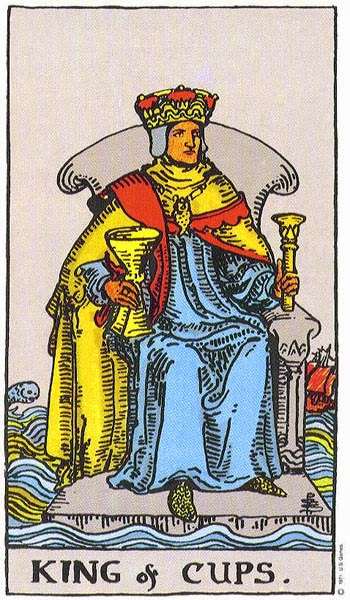
 The following was inspired by the Tarot card of the King of Cups (pictured at the head of this post).  I had read Jessie Weston's From Ritual to Romance because it had influenced T. S. Eliot, as he explicitly states in his notes to The Waste Land.  She wrote of the Grail legend, of ancient fertility rites and Christian overlays, and she discussed the symbols in the Tarot deck as expressing some of that semi-underground tradition.  Now, any good fundamentalist would recoil in terror as I acknowledge that as a Baptist seminarian I gave some attention to the Tarot.  They would say, "See!  There is where he went wrong, turning to the occult."  I would say, "Codswallop!"  My mind works in symbolism and I do not fear to venture where Eliot has gone.  I do not, in any case, ascribe metaphysical reality to any occult symbol.  I think astrology is bullshit if you actually promulgate the idea that the position of the planets and stars shapes destiny.  I do, however, gladly accept that the symbols of astrology, mythology, etc. provide tools for us to discuss, in very powerful and helpful ways, the psychic realities of our lives.  This is why I can say that I am a Taurus.  It is easy, shared symbolism.  And I will go further to say I am very skeptical of any Christian metaphysics as well.  All language is metaphorical so what I say of God is symbolic, limited, inadequate, and--even though it may point toward the truth--remains untrue.

But back to the poem:

The King of Cups
The waters roll and toss; they grow and swell
with hidden purpose, splashing freely now,
then gathering their random force to burst
upon the shore.  What strength can break or quell
their strange attack?  Who shall withstand the thrust
of their aggression? Rising to surround
the rockbound isle, they lap now at the throne
and at the feet of him who holds in trust
the power of life.  With calm command, his brow
unwrinkled and benign, he stoops at first
to fill his cup and drink.  Then, at the sound
of his voice they recede, as if to bow
and acquiesce.  The only king they own
acknowledges their faith, yet sits alone.

1 August 1971

Why this card?  Well, I read somewhere that the King of Cups was the card of the theologian and what was I back then but a budding theologian?  I have said many times throughout my life that I have always thought as a theologian.  Between my inherent mysticism and sacramental mindset (words that Baptists do not use but have always been part of me), I found it difficult to experience or conceptualize anything without reference to the Ultimate and to the ultimate questions.  The last fifteen years, roughly, have reflected a shift in my journey in which those two aspects (mysticism and sacramentalism) have emerged more strongly and ecclesiastical trappings have increasingly fallen away.  To see God as permeating yet transcending everything that is makes me a firm panentheist and back in Baptist seminary we discussed that and some of us, at least, were convinced that this was orthodox and probably necessary if we were to make any sense of creation and experience. When one sees "the veil of Temple rent in twain" and any distinction between sacred and secular as artificial and unhelpful, then it becomes difficult not to see the divine everywhere.  And since, by a combination of choice and circumstance, I have spent most of my working life "in the world" (what a silly phrase), it is in the world that I must, and do, experience the holy and live out my ministry as it takes many surprising shapes.  The Church has seemed increasingly irrelevant to the lives of those around me and, though it has formed me deeply, I consciously try to avoid using its obscure, precious, and frequently misleading language.

As for this poem, clearly related to the one before it, there is this sense of threat and isolation. Will the savage waters rise and drown the King?  You can easily note that the card itself does not posit angry waves that threaten, only that he is surrounded by water.  It is rather my own projection, my personhood that feels so isolated and cut off, so threatened by all around it.  The poem expresses a few things.  One is transformation.  These would seem to be sea waters, based on the card's depiction of a large vessel in the background, yet the King fills the Cup and drinks, so the waters are somehow sweet and life-giving.  He draws water by stooping, so although he expresses calm--even wordless--command he is not rigid or haughty, simply secure and in control.  I see here a projection of how I wish I had been back then.  If there is anything I was not at that point is was secure and in control.  I was a closeted queer in an evangelical context, hoping to be ordained.  I would, in the following year, be so overcome by anxiety that I would fail my oral exams, reduced to a terrified, inarticulate mess.  I retook them a week later and did fine, but secure I was not.

The man on the throne and the waters all about him are in harmony.  Yet he remains in isolation.

The poems here were written just two years after the Stonewall Riots in 1969.  The drag queens and their allies, bless them, stood up for themselves and the world would not be the same.  As courts across the United States find that equality before the law includes the right of marriage equality in 2014, we are now in a very different world.  Back in 1971 to be deep in the closet and hope to become a minister of the Gospel was about as insecure as you could get.  I was very, very alone.


Breaking down the walls

What is the cost of breaking down the walls,
and what the price of lowering the bridge?
What is the risk of teetering on the edge
and what the end of him who slips and falls?
Do they really crown the victor? What's the catch?
Should I really try to trust you? Do you care?
Do I really want to open? Do I dare?
Will I always choose to sit it out and watch?
Am I tossing empty questions to the air
as in a game, only to receive them back
unanswered? Do I really seek to crack
our of my shell? Why do you simply stare
at my deliberations? If I try,
will you help me come to life, or let me die?

August 1971

So, I was clearly wrestling with all of this back then.  But I lacked the inner strength, the experience of living, and safe allies.  As I look back I am convinced it was not safe then.  I did come out "as bisexual" to a handful of classmates.  They took it calmly, except for the woman I was dating.  It was very hard on her and I can only hope that from the other side she can forgive me.

Now forty-three years have passed since these writings.  So very much has happened.  When I dropped out of the doctoral program in history at UCLA in 1974 I did not break down all my walls but I partly opened my closet door and partly had it yanked open for me.  I could stop pretending to be straight, or even bi, and just be my gay self.  Yes, in fits and starts, and it took a while before everybody knew and I no longer cared.  When I dropped out, Mom wanted me to come home.  I was firm in rejecting that suggestion.  It would have been death on a thousand levels.  Poverty and struggle in Los Angeles were infinitely better than the straightjacket of fitting back into familiar (and false) patterns.  Families fall so quickly and unconsciously into old patterns that to this day I have zero sense that I can relax and just be me around family.  I am sure that on some levels they understand this, though I seem so anti-social by limiting visits to once very five years or so.  It only takes a few hours for me to be climbing the walls, even though I love them and rejoice in their happiness and grieve for their sorrows.

In any case, a number of walls fell a few years after this poem.  Others remained firmly in place until recently. 2013 was a year of many transitions.  Three very special men came into my life and taught me that I am capable of so much more than I thought. They are still, if only at a distance, part of my life (and daily prayers) and I will forever be grateful.  Over the past year I have also had to "let go" of each one and on several levels had to let go of my best friend as well, not for any sad reason but because he has a new love and life partner, a wonderful man.  I wish them all happiness and support their relationship, but I no longer am able to rely on the man I spent twenty-four years with for a huge amount of my social life and main emotional support.  It is right and good, and good for me especially, that I must learn to do things for myself.  Long overdue.  2014 and beyond are the Years In Which I Must Finally Grow Up.  Yeah, I know.  Kind of slow on the uptake there, BB.  In any case, I want to thank Chris, Brian, and Math for helping me break out of my shell.  The final walls are falling and I no longer choose to sit it out and watch, or remain passive.  And Bill, who has been there for almost thirty-seven years, I thank you for the hard conversations we have had to help us both heal and grow and move forward. And my shrink, who has proven to be a perfect companion at this particular point. Thanks also to my coworkers who have listened to me endlessly talk about the roller coaster ride of the past two years and have been there every step of the way with their friendship and support. (This is where the drunk tears up and says, "I love you guys!")

So, in short, I am trying, and those around me have proven safe and trustworthy and are helping me come to life.


The morning caught its breath

The morning caught its breath
when the halfgreen tint of sky announced
the sun's brief hesitation.
A squirrel darting behind a clump of firs
distracted my wonder and nearly made me fall
from the whitened log I balanced on,
forcing me to grab the sticky limb
of the cedar to my left.  When I looked up,
the sun was there,
shooting goldstreaks through the haze
in the valley where my heart leaped
to welcome the day.

August 1971

Not sure this needs any comment.  It speaks of my sense of being at home in the forest and rejoicing in simply being.  A good place to pause for today.

--the BB

Saturday, October 11, 2014

Sulla strada dell’esilio


Paris Night

Upon the stonework bridge I stood
   with shoulders bent and head
And listened to the songs of night
   sung by the river below
And the clouds above which veiled
   the winter moon, so far
From what I once called home
   yet farther still from all I'd dreamed.

A shadow in the alleys of the heart
   wandering in fear and hope
Surrounded by the memories of now
   and then and tomorrow
Squeezed into a moment caught between
   the massive centuries
Yet living in that moment all
   unuttered human drama

Now sensing in my soul that night
   forever there yet gone
I know of many waters fled
   beneath the bridge of stone
And much to flow.  I await
   the ultimate union
Of river and sea, of sky and earth,
   reality and dream.

Cum subit illius tristissima noctis imago,
Qua mihi supremum tempus in urbe fuit,
Cum repeto noctem, qua tot mihi cara reliqui,
Labitur ex oculis nunc quoque gutta meis.

20 mai 1968

The closing quatrain is Ovid, Tristia 1.3, in which he laments his exile from Rome.  One translation is as follows:

When the saddest memory comes to mind,
of that night, my last hour in the city,
when I recall that night when I left so much
so dear to me, even now tears fall from my eyes.

The photo shown here was taken in May 2014.  I am sure the view was less brightly lit when I stood in the same spot in December 1967, a young student far from his native California yet who felt so at home in this great and beautiful European capital.

This is one of the items buried amid chaotic gibberish in the journals of my college and seminary days.  Evidently written just before my college graduation it speaks of the memories and yearnings awakened during my semester abroad.  The "many waters fled" suggest the immense changes I felt within from my time in France, experiencing a different culture, thinking and even dreaming in a different language,  learning to eat and dress and behave somewhat differently from the ways of home.  Memories "squeezed into a moment caught between the massive centuries" even today makes me think of the exterior reality of walking down streets with stone walls on either side, ancient walls (especially to someone whose entire life had been lived on the West Coast).  In fact, I walked each day past Notre Dame de Paris going to and from my hotel.  And here was my little life caught in that immense context, and feeling that I was very much part of it while simultaneously a stranger in its midst.

Well, let us assume a kid who cites Ovid in Latin must have some feeling for centuries of history.

Exile, journey, and longing for a home still unknown are undoubtedly themes of my life and now that I am in my late sixties it is certainly time to reweave these threads into some deeper wholeness.  The Italian title ("on the road of exile") comes from Turandot, possibly my favorite passage in the opera:

LIÙ (si avvicina al Principe, piangendo)
Signore, ascolta! Ah, signore, ascolta!
Liù non regge più!
Si spezza il cuor!
Ahimè, ahimè, quanto cammino
col tuo nome nell’anima,
col nome tuo sulle labbra!
Ma se il tuo destino
doman sarà deciso,
noi morrem sulla strada dell’esilio!
Ei perderà suo figlio...
io...l’ombra d’un sorriso!
Liù non regge più!
Ah, pietà!

IL PRINCIPE IGNOTO
Non piangere, Liù!
Se in un lontano giorno
io t’ho sorriso,
per quel sorriso,
dolce mia fanciulla,
m’ascolta: il tuo signore
sarà domani forse solo al mondo...
Non lo lasciare,
portalo via con te!

LIÙ
Noi morrem sulla strada dell’esilio!

TIMUR
Noi morrem!

IL PRINCIPE IGNOTO
Dell’esilio addolcisci a lui le strade!
Questo, questo, o mia povera Liù,
al tuo piccolo cuore che non cade
chiede colui che non sorride più...
che non sorride più!


***

LIÙ (weeping, approaches the Prince)
My lord, listen, ah! listen!
Liù can bear it no more!
My heart is breaking!
Alas, how long have I travelled
with your name in my soul,
your name on my lips!
But if your Fate
is decided tomorrow
we’ll die on the road to exile!
He will lose his son...
And I...the shadow of a smile!
Liù can bear it no more!
Ah, have pity!

THE UNKNOWN PRINCE
Don’t weep, Liù
If one far-off day,
I smiled at you,
then for that smile,
my sweet girl,
listen to me: your master tomorrow
will be perhaps alone in the world...
Don’t leave him!
Take him away with you!

LIÙ
We’ll die on the road to exile!

TIMUR
We’ll die!

THE UNKNOWN PRINCE
Soften for him the road to exile!
O my poor Liù, this, this
is what he who smiles no more
asks of your unfailing heart...
he who smiles no more!

Darkslayer, books one and two of The Chronicles of Mídhris, tells of my young hero Ian Dyrnedon who slips between dimensions and finds himself in a parallel world.  He never returns to his family in Yorkshire and is forced to make his home in a new world and among a new people. There he finds such happiness and peace as he can, though life forces upon him so many and such strong experiences that there is always a restlessness, a source of perpetual uneasiness for his wife, a strong woman whose sole weakness is concern for him.

Books three through eight have similar threads in the story lines and the final two volumes (should I live long enough to get them written) bring the story of the redactor of the Chronicles, my own alter ego, who suffers an ultimate parting no words can capture.

I suppose the two clearest life tasks I now face are making sense of the journey of my life and getting the story of the Dyrnedon family journey into published (or publishable) narrative.  Whether any other huge tasks will come to pass remains to be seen, and I am agnostic there.  That I leave to Christian grace and Eghran's chance.


--the BB

Thursday, October 09, 2014

Ho i miei libri


I have my books
And my poetry to protect me;
I am shielded in my armor,
Hiding in my room, safe within my womb.
I touch no one and no one touches me.
I am a rock,
I am an island.

And a rock feels no pain;
And an island never cries. 
--Paul Simon

 
I was a huge fan of Simon and Garfunkel.  Their first album, Wednesday Morning, 3 AM, was released on October 19, 1964.  I started college in fall 1964.  Going back to those songs is total nostalgia for me.  A wistful alienation, so common in that era, spoke to me.  They were overshadowed by the Beatles but I much preferred Paul and Artie.

There is no question that I saw the tragic sadness of anyone so cut off from others as the narrator of "I am a rock," and I did not hold that as any kind of ideal.  I admired the skill with which Paul Simon's words and music captured this kind of isolation, a shielding from the hurt that others can inflict, a defense against vulnerability, love, loss, betrayal, doubt, etc.

Tonight I listen to this song and look at these lyrics and think, "OMFG, that is truly who I was when I first fled my home town to the exotic environs of Claremont, California."  From the perspective of maturity I can look back and see exactly how deeply armored I was (and have been).  The added resonance of the moment lies in my current project, returning to the books of my youth to relive my journey, only this time without so many defenses.

I confessed in an earlier post that I have seen trees as guardian spirits: friendly, safe, watching over me.  I have often preferred trees to people. With trees I have never been pressured to perform, to be something I am not.  I am safe with trees.  Extending the imagery a bit, from trees we make books.  If trees represent the external (non-human) world in which I feel safe and which exalts my soul, then books represent the internal world in which I feel safe, the world of my mind and imagination, the meeting ground of souls across time and space where ideas and emotions are shared... but at a remove. A book or an idea may make some claim on me, demand some response, but there is not a physical person facing me: the situation where I immediately start to gauge "what does this person want from me?" and start to shape myself to that intuited, projected, genuine, or utterly misread desire of the other.  In short, when I am with other people my knee-jerk response is to abandon my self-hood in order to respond to them or elicit a response from them.

When one has done that for almost seven decades it is difficult to stop.

There is an element of shock in finding myself musing on this tonight.  As I seek to break out of the ancient patterns that initially allowed me to survive but then crippled me across the years, here I am going into one of my greatest retreats: books and the inner world of my mind.  Then again, the way we find healing of our past wounds is by naming them and dealing with them, often reliving our past, seeing if from new perspectives, letting ourselves grieve (with all the steps of denial and anger and bargaining, etc.), and eventually coming to peace.  We can acknowledge our very personal truth, honor both the good and the bad, keep what is of value, let go of the rest, and move forward.

So I retreat once more, but this time quite consciously and with the guidance of a good shrink, with a heart full of hope, and with friends who graciously put up with and support me in this journey.  I go within in order more freely and honestly to open up and open out.  As Hestia helps me to guard the hearth fire of my heart, the security of the inner flame can allow me to open more doors and windows and not hide a terrified spark behind so many barriers.

Beginning with my college years I kept journals.  I think I had thirteen notebooks eventually and only a few years ago tossed almost all of them.  I thought I could walk into my library right now and pull out the first one, started in my freshman year--contemporaneous to my early listening to Simon and Garfunkel. What I laid my hand on was volume two, spanning from July 1970 through January 1976.  Now this is going to be interesting reading!  Here is an early snippet, selected for the obvious link to the theme of Odyssey.

15 novembre 1970
"Odyssey"
Always going forth hoping to find
eternal journeys toward the evening
and the unknown - my own odyssey -
endless descriptions beyond the door
which marks my beginnings and measures the rhythms
of missed returns.  And so I wonder,
as I start my search just once again,
if destinations lurk beyond
the shadows of night, and if I might
perhaps this time be able to pierce
the curtain which cuts my dawn from my dusk,
airwoven mistwebs tangled in branches,
memories caught in my moments to snare me.
Then the mingled fires might greet me,
sunset, lamp, and hearth together,
waiting for my weary footfall
coming up the steps and crossing though
the door at last and knowing I was
home.

[Below that is written: "That's a lousy vehicle for two lines."  I have no idea now which two lines.]

 I am tempted to comment: "Holy fucking shit! The conclusion of that poem is basically the ending of Darkslayer, Volume Two."

The thing is, of course, that my books and my poetry do not protect me.  Yes, they give me a safe space to ponder but they also pierce me to the depths, nourish me, challenge me, and remind me of truths deeper than words.  And, even if only in private, they have kept me vulnerable.  Rather like the desert monastics in the third and fourth century who fled to the Egyptian desert and there, in such incredible isolation, united their beings to the cosmos and to God, facing within themselves all the life-and-death struggles of the society they seemingly left behind.

So my current plunge into classic texts seems, to me, anything but safe.  I am off on the hero quest. There will be monsters.  Whether I need to slay them or befriend them or both or neither remains to be seen.  There is no formula, no rulebook, no guarantee. As my friend Lee shares in the old proverb:
Caminante, no hay camino; el camino se hace caminando.
[Traveler, there is no path; it is made as you go.]
 

 I also want to add that in the past few days some pains that I have admitted with my head but had immense difficulty feeling in my heart and gut now seem to be surfacing and I give great thanks for this.

--the BB

Wednesday, October 08, 2014

Chi non ama

My current odyssey involves looking into my distant past and all my journey since, seeking the threads woven into the fabric of my life, the connections, the clues, the glorious adventures and disastrous wrong turns--and making some kind of sense of it.  I did not type "find some kind of sense" but "make some kind of sense."  The extremely rational part of me that views the universe as a complex marvel of quantum mechanics considers everything to be a dance between Randomness and Pattern.  Randomness means we mostly waste our time asking about purpose but that does not deny meaning.  We create meaning as we tell our stories, giving shape to events.

Rephrasing this somewhat: Does everything happen for a purpose?  I do not believe so. Most stuff just happens.  To believe everything happens for a purpose implies that there is a force controlling everything (goodbye free will) and that this force purposes all sorts of disaster and meaningless suffering.  I cannot buy that. Hello, Theodicy 101. Which is background for this essay, though not truly its central issue.

Anyone who knows me is well aware that I have a questioning mind.  In fact, even more questioning than appears on the surface because a lot of skepticism, evaluation, doubt, and testing is going on in the background that I don't even bother to discuss.  I did not make life easy for my teachers.  I even uttered "bullshit" during a class in seminary.  Yes, aloud.

And what about the role of faith?  Ah, any survey of my life journey would find mountains of material around faith.  Yes, there are things I accept as basic, regardless of any lack of empirical proof and sometimes in the face of contrary evidence.  But that body of faith assertions is very limited and has grown smaller over time.

I have always had a problem with "faith" being invoked to short-circuit rational inquiry, to dodge contradiction and inconsistency, and to bully people into silence and unthinking obedience.  And the evidence for that kind of "faith" (invoked as a weapon) is vast and overwhelming.  I grew up with it.  I spent my summers surrounded by Fundamentalists (I capitalize the word to insist on its original historical context among a subset of conservative evangelical Protestants).  I did not. Fit. In.  I am quite aware that I will be reacting against religious fundamentalism to the day I die.  If my rants against it are problematic for you, feel free to skip most of my posts because my abiding pain and anger do not incline me to go gently.  I do hold such preachers and teachers and organizations responsible for much that is wrong with the United States today and for the anguish, fear, and anger they infuse into their listeners.  If I believed in purging people from society, which I do not, that is where I would begin: pastors.  Yes, I know.  I am a clergyman. Why do you think I know this shit from the inside?


Image from Wikipedia, released to public domain

The heart of stubborn adamant
unyielding would resist
the twists and turns, bullshit and cant
that others would insist
must have assent, must be believed,
set limits to the mind.
That tender, rocky heart was grieved.
It knew the Truth was Kind.

That is a piece of doggerel I composed last night.  I do not offer it as I do poems of which I am proud but as something that captures part of my truth.

Part of my challenge in relating to other people has been the defense I developed early on in order to resist the pressure from without to conform: to say things I did not believe, do things that made me uncomfortable, not do things that gave me joy, deny my feelings and my needs, and attempt to be someone other than myself.  Yes, as a clever, white, middle-class, Protestant male in post-WWII America I had incredible privilege denied to those who started life without those unearned advantages.  Yet even in that privileged context there were messages, constant messages, that there were things wrong with me. When you look simply at sexual orientation, this means who I am is wrong, not just what I believe or say or feel or want.

To live with that judgment, always unspoken but sometimes shouted from pulpits, can lead to a crushed soul.  To many it opens the door to despair and suicide.  That was not my temptation.  But in order to survive I kept a spark within me buried so deep even I could rarely remember it existed.  It was protected by granite, adamant, and steel.  I should not be surprised if a cherub or two also watched over it with a flaming sword (thanks, angels, by the way).  My soul was protected because it was locked in a prison.  You were a rare soul, indeed, if I ever invited you past the first few gates (and they were countless).

I could appear expressive, in touch with my feelings, outspoken, etc. but that is because the surface persona was as free as the deep self was tightly bound and hidden. Performance.  We introverts perform a lot when around people.  Now that I am trying to be authentic it requires immense shifts in my perceptions and behavior.  No small task.

So here this introvert is sharing these deeply private musings publicly on the internet.  Bizarre, yes?  It is easier to open up at a distance.  I am not watching your face for clues, dear reader, that might shape what I say.  Instead I attempt to speak my truth and you may make of it what you will.  I need allies to share this journey with and I hope at least some of my real life friends in what some call "the meat world" will read and engage what I write here.  I hope they will be gentle. As strong as I feel these days, and ready for change, this remains scary stuff.

One of the most immense shifts of this past year is that I have ceased attending church.  There was a time as a devout Catholic (not Roman, just Catholic) Christian I missed being fed if I did not attend Eucharist and receive Communion every week. (Yes, I was a lousy Protestant; way too mystical and sacramental, and Protestants don't even speak those languages.)  I do not miss it now.  My life is lived in the world, out with the tax collectors and prostitutes and sinners and drunkards that Jesus hung out with, if you will.  Most church language sounds meaningless to most people and I just cannot try to speak it any longer.  If I still believe in Good News (and I do), then I must share it in ways that make sense and that is mostly by the way I am with other people.

I am rather agnostic on all matters metaphysical.  As a language major I view all expression as metaphor.  The word is never the reality we try to communicate, it is a symbol, usually at several levels of abstraction.  No word can capture any reality, much less a transcendent one. This does not relieve us of the the task of communication.  My personal, mystical experience of the Ultimate calls for some response from me.  The language I use may all be symbolic but that is all right.  For me it is the language of Love.

There is incredible comfort between me and my atheist, agnostic, and pagan friends, not to mention folks of many faith traditions.  I feel no compulsion for them to believe any set of doctrine.  I want them to experience love and to rejoice in it.  As I said to a friend years ago, "I am not troubled that you no longer believe in God.  I believe that God believes in you and that is enough for me."

I would like to be clear that when I defend my right to my own selfhood, feelings, thoughts, and needs I am not rejecting our relationship to society and the larger whole or denying responsibility toward that context. But I am defending us all against mindless conformity.

All those decades when I feared causing trouble for family or church by expressing who I am and what I feel and think....  And the trouble I have gotten into when I expressed myself freely.... All I can say is: Fuck that noise!

This blog is my blog for my musing and my sharing.  I have some really rude words for those who got their knickers in a twist when I was trying to serve the church for nothing more than the satisfaction of being faithful, but I won't kick up that dust today.  It is nice to be retired from church. I simply can no longer fight the fight against meanness, willful ignorance, and hatred in the name of Christ--and I do NOT speak of the congregations where I served or the dioceses to which they belong, but to that vast, heretical, hateful phenomenon most Americans witness as Christianity. Where people worship God, love each other, and serve their communities they have my unqualified blessing.  Where communities try to straight jacket though and behavior, they have my hearty curse. 

Do I still believe anything?  Actually, yes.

Chi non ama non ha conosciuto Dio, perché Dio è amore.


As the Rabbis Hillel and Jesus said: Love God.  Love neighbor.  Love self.  The rest is commentary.

--the BB

Saturday, October 04, 2014

E piangevo

This post has links to my current reading, to things I have stumbled across on the web by chance and things I encountered while searching for something different.  It involves some of my deepest pains and passions.  It is about yesterday, today, and always.


Rembrandt's Prodigal Son
Hermitage Museum, St Petersburg
This photo was just taken in my hallway 
where a print I bought at the Hermitage hangs.

I want to begin with the most striking take on the familiar parable of the prodigal son that I have ever encountered.  The story comes from commentary on a current crisis in a seminary, but that is not part of my story today.

[The commenter] was once doing a bible study on the Prodigal Son, asking each member to share with whom they identified -- the older son, the younger son, or the father, and why.  One person had not shared, so [I] invited her to speak. "No," she said, "what I have to say is stupid."  [I] assured her that it was not, and her reflections were as valid as anyone else.  "I identify with the Fatted Calf," she said.  "Think about it:  the Fatted Calf is the only one in the story that didn't do anything.  The younger son ran off, the older son was resentful, the father gets to be the good guy.  The fatted calf was happily eating his slop one day, next thing you know, he's dead.  He suffers because of the decisions others have made."  
 It seems that most humans throughout history are in the situation of the fatted calf, suffering poverty or war or oppression because of the decisions of others.  I just finished reading the opening argument between Agamemnon and Achilles in the Iliad. Each of them gets his fee-fees hurt, as we now say of big bad persons whose delicate feelings are disturbed and then proceed to make a huge stink about it. For that the Trojan War is prolonged and many die horrible deaths.  For that matter, the entire story of the Trojan War traces back to bruised feelings.  Eris is not invited to a feast, a golden apple sets  up rivalry, and then all hell breaks loose.

But Achilleus weeping went and sat in sorrow apart from his companions beside the beach of the gray sea looking out on the infinite water. (Iliad I.348-350, tr. Richmond Lattimore)
He had been publicly humiliated, though he gave as good as he got when it comes to insults.  So more death ensues, including death of comrades.

Whenever we read of mighty deeds by glorious heroes there is usually an ineluctable consequence: death.  Who pauses to think of the "common" person, the innocent victim, the collateral damage?  Do U.S. drones protect us in any lasting sense or merely sow the seeds of future terrorism, a harvest that must one day be reaped?  For any talk of surgical strikes we know there is no such precision.  People die for the decisions of others, by instruments guided from the other side of the world.  And the decisions of others, throughout human history, are not always rational but rather driven by our deep passions and dark anxieties.


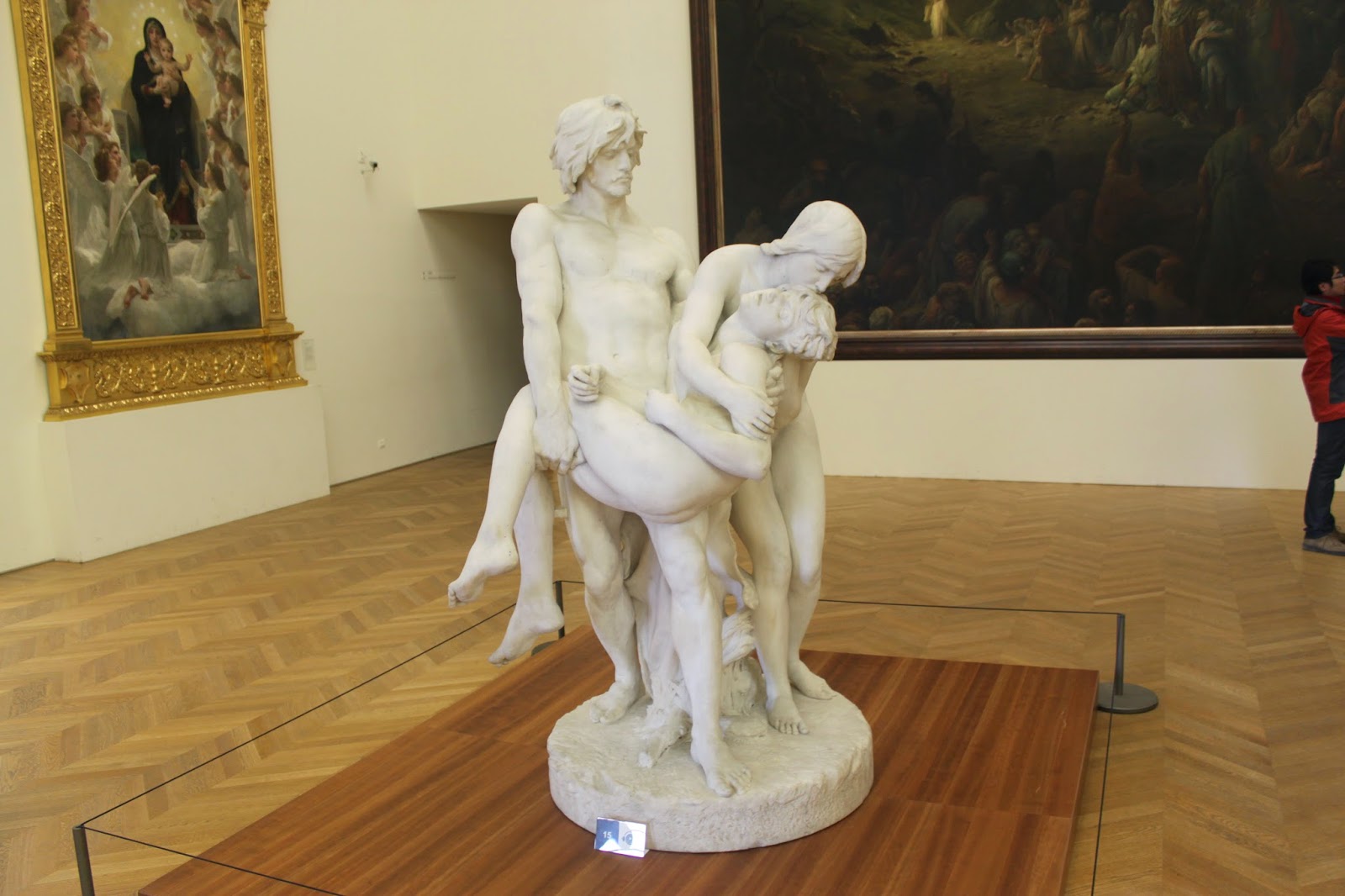
"The First Funeral" in the Petit Palais, Paris.  I took this photo in 2012.  Adam and Eve first taste death in the loss of their son Abel, victim of his brother's envy.


Almost a century ago the world witnessed, though some of it still denies, the Armenian genocide.  I grew up among survivors and their descendants.


Genocide in Darfur, South Sudan.


The Holocaust under Hitler.  And I lived among survivors and descendants of this genocide.


The Killing Fields of Cambodia under Pol Pot.  I also worshiped and ministered among survivors of this genocide and their descendants.


Kosovo, 1999.


The muddy fields of Passchendaele, WWI.


Rwanda, the genocide we all ignored.

Perhaps it is easier to step back from the mass horrors, they are so overwhelming.  Yet even one human lost because of the passions of others remains tragic.  I posted a while back about how this sculpture touched me as I was becoming sexually aware but continues to move me deeply as it captures the dying moments of a warrior far from home. And what of the wounded warriors who return but cannot leave the battle behind them?  Ever.


The Dying Gaul, Palazzo Nuovo, Campidoglio, Rome

But if we move to the particular we find ourselves facing the individual, the personal, the familiar: people we know or have known.  These are the loved ones, the relatives and friends, the friends of friends, the neighbors, the men and women we see in our communities or transiting through airports. We know some of their stories.  Or, more likely, we will never know because they are unable to tell them. What has been called shell shock or battle fatigue is now named post traumatic stress disorder, or PTSD.

What deadly sacrifices do we insist on making, generation after generation?

I had to scroll back quite a bit to see where I posted this on Facebook:
Think / Neither fear nor courage saves us. Unnatural vices / Are fatherred by our heroism. Virtues / Are forced upon us by our impudent crimes.
--T. S. Eliot, Gerontion (1920)
In spite of all I am writing here, I do believe in a true heroism.  This is seen in sacrificial action in the face of, not the denial of, fear.  I believe most heroes are those who do the kind and generous and true and noble thing in everyday life, even when it costs them in time, effort, anguish, pain, and doubt.  Especially in moments where there are no easy answers.

But then there are the dark demons that tell us we are doing something noble, important, and worthwhile.  And we sacrifice to those demons.  Not only ourselves but we sacrifice others.

Rembrandt again: The Sacrifice of Isaac


Akedah
To all the sons not rescued by a ram,
To father’s gods and demons sacrificed,
Whose bonds were never mercifully sliced
And thus became themselves the offered lamb:
This mount was surely never sacred ground;
Just one more evil spot upon the earth
Where death could reign instead of joyous birth
And witnesses were deaf to victim’s sound.
The Lord did not provide.  You bore the flame
Of your own holocaust and hauled the wood.
You both assembled stones and then you stood
And wondered what would happen.  Then it came:
The moment when all filial trust was broken
And you, yourself, became the demon’s token.

Paul E. Strid
20 March 2014
Not all the stories have a happy ending.  I have no problem saying I do not believe in any deity that would make the demand narrated in Genesis 22.  It is too horrible a story, though it is also far too true in human history.  I believe in a God who never needs, and never required, to have honor satisfied or arbitrary justice fulfilled, to demand sacrifice to be placated, or to see the blood of Jesus to make everything all right. That God in Christ bled and died to satisfy our blood lust: that I grasp all too well.  I was raised on the most awful atonement theology and a sadistic streak runs through it, speaking of our own need for something terrible.  It has troubled me all my life and I gradually came to reject it and I totally renounce it.


And so we join Rachel, weeping for her children. She is another Eve from The First Funeral, only now her children are more numerous and senseless slaughter has multiplied.  She is the Sorrowful Mother.

I do not know the ultimate source of the words that follow.  I came across them on tumblr.


e piangevo, perchè sapevo che l’avrei sempre avuta dentro, quella tristezza che mi fa sentire vuota, che non si può speigare

[and I wept, because I knew I would always have within me this sadness that makes me feel empty, that I cannot explain]


This is a crucifix attributed to Michelangelo in the Basilica of the Holy Spirit, Florence.  It is the bookmark I am using as I read the Iliad.  It keeps me mindful of the cost of our passions.

Jesus Christ the same yesterday, and to day, and for ever. --Hebrews 13.8
Just as suffering and slaughter as a result of the decisions of others is the same yesterday, and to day, and for ever.


--the BB

Thursday, October 02, 2014

Torpore e rimpianto

The shade of Tiresias, consulted by Ulysses in the underworld


In English 101 we read T. S. Eliot's The Waste Land.  It seems an incredibly undisciplined poem, roaming all over the place as though Eliot could not rein in his love of words and how they sound, heaped upon each other, with allusions going in all directions.  It is a veritable tour through mythology and imagery.  Vegetation deities and the Paschal mystery, the two already hardly unacquainted, and the history of European literature all seem to bounce about.  Well, as a lover of words and images and mythology I could only fall in love with it.

As Barbara Kaiser and I walked toward our English class with Dr. Barnes on the day this poem was to be discussed, we had a chat.  I do not recall who initiated it but I do remember we always called each other Miss Kaiser and Mr. Strid, mimicking in reverse the way all professors at the school were addressed with no "Doctor" thrown in. Whichever of us began, it ran something like this:
Well, Miss Kaiser, what did you think of The Waste Land?
I hated it, Mr. Strid.
Really?  Why?
I couldn't understand a word of it.  Could you?
No, but I loved it.
How can you love it if it makes no sense to you?
It doesn't have to.  I just loved the words and the way they sound.

This may be a poor approximation of the words, but I assure you it was the content.  I have read and reread the poem many times, savoring Eliot's notes.  I loved that it incorporated fragments of so many other works (and in several languages).  My polyglot mind must have danced.  A couple classmates and I even recorded our own dramatic reading (reel-to-reel tape, children).  Many years later I ran across Jessie Weston's From Romance to Ritual, which inspired the work, and read that plus rereading Eliot, with a deck of Tarot cards at hand as well.  I have read it dozens of times, I suppose, and also came to love The Four Quartets by Eliot.  But they were the subject of a series of musings on this blog some time back.

Some segments of The Waste Land delighted me with their wit and invention.  Some amused me highly.  The poet knows how to do the most literate snark.  Some passages invite prolonged reflection.  Occasionally I am overwhelmed by the imagery, just as one can be overwhelmed by the perfumes in section two on "A Game of Chess."  Some phrases stir up some deep shit bred of memory and desire.  And then there are scenes that touch some barely perceptible chord deep within, evoking a stirring, perhaps a touch of disquiet or tender sympathy.  I believe disquiet and sympathy lie behind this post.

Here is the scene that triggers my musings:

At the violet hour, when the eyes and back
 215
Turn upward from the desk, when the human engine waits

Like a taxi throbbing waiting,

I Tiresias, though blind, throbbing between two lives,

Old man with wrinkled female breasts, can see

At the violet hour, the evening hour that strives
 220
Homeward, and brings the sailor home from sea,

The typist home at tea-time, clears her breakfast, lights

Her stove, and lays out food in tins.

Out of the window perilously spread

Her drying combinations touched by the sun’s last rays,
 225
On the divan are piled (at night her bed)

Stockings, slippers, camisoles, and stays.

I Tiresias, old man with wrinkled dugs

Perceived the scene, and foretold the rest—

I too awaited the expected guest.
 230
He, the young man carbuncular, arrives,

A small house-agent’s clerk, with one bold stare,

One of the low on whom assurance sits

As a silk hat on a Bradford millionaire.

The time is now propitious, as he guesses,
 235
The meal is ended, she is bored and tired,

Endeavours to engage her in caresses

Which still are unreproved, if undesired.

Flushed and decided, he assaults at once;

Exploring hands encounter no defence;
 240
His vanity requires no response,

And makes a welcome of indifference.

(And I Tiresias have foresuffered all

Enacted on this same divan or bed;

I who have sat by Thebes below the wall
 245
And walked among the lowest of the dead.)

Bestows one final patronizing kiss,

And gropes his way, finding the stairs unlit…


She turns and looks a moment in the glass,

Hardly aware of her departed lover;
 250
Her brain allows one half-formed thought to pass:

“Well now that’s done: and I’m glad it’s over.”

When lovely woman stoops to folly and

Paces about her room again, alone,

She smoothes her hair with automatic hand,
 255
And puts a record on the gramophone.
 It is a tawdry vignette of two people doing what lost and lonely people do.  When I read it as a freshman I was, no doubt, initially tittered, then troubled, amused, and saddened.  I find it disturbing, far more now than back when I was a frustrated virgin.  Before I add my personal reactions I want to
add what Eliot says in his notes to the poem:

Tiresias, although a mere spectator and not indeed a “character,” is yet the most important personage in the poem, uniting all the rest. Just as the one-eyed merchant, seller of currants, melts into the Phoenician Sailor, and the latter is not wholly distinct from Ferdinand Prince of Naples, so all the women are one woman, and the two sexes meet in Tiresias. What Tiresias sees, in fact, is the substance of the poem. 

Tiresias, the blind seer, is mentioned in Ovid's Metamorphoses as having struck two coupling snakes and been turned into a woman for seven years.  When he sees coupling snakes again he strikes them and is turned back into a man.  As one who has "seen both sides" he was called upon to settle a dispute between Jupiter and Juno over which sex gets the most pleasure out of lovemaking.  That is background; you can read his verdict and its consequences on your own.

As a gay man I can experience the delights of both pitching and catching, so there is a certain identification with Tiresias, though I have never wanted to be anything but a male.  Role confusion I may have known in a society of rigid expectations but never gender confusion.  Still, I can identify with both the man and the woman in the scene cited above.  Like any male I am patterned by biological evolution and societal encouragement to take advantage of opportunity where it presents itself.  When I was young and pimply I could barely recognize opportunity when it came knocking and I was too terrified to take advantage of it (I believe there was one chance in high school that haunts me still) or, well, too icked out at the thought of doing anything beyond a hug with a female.

The woman here, however, captures a theme I have already raised in this extended biographical pondering.  I have lived a life with weak, often non-existent, boundaries.  I would give without even being asked.  What I gave was my own selfhood.  In order to survive I have always kept a core locked away and inviolable and if any reader has ever had trouble connecting with me, now you know why.  Like the typist, I have endlessly been in situations where others and their ideas, intentions, and actions have been, by me, unreproved even when undesired.  I have gone along, said "yes," felt used and resentful, violated, and almost never uttered a word of resistance or reproach.  the most profound alienation existed between that with which I went along and what I felt inside.

Gradually, and very late in the game, I am getting better at (1) being myself, (2) standing up for myself, (3) speaking my truth, and (4) clarifying and defending my boundaries.  This latter is quite different from the defenses of the past, the great walls and moats, deep dungeons bound with adamant and steel.  Those preserved the endangered sparks of my threatened self, threatened because I had not learned to be strong in who I am.  True, I have the stubbornness of a Taurus, and can dig in my heels when I feel manipulated but mostly I just practiced passive aggression.  I could not be clear and communicate honestly; I simply refused to give others what they wanted.  The mere fact that these current writings are posted publicly, where friends, family, and strangers may read, is an indication that the deep dungeon door, so long defended, has inched open.

Today I feel no need to rage about this.  Well, not at the moment anyway. I have lots of grieving to do and anger still to process.  But mostly it is sadness.  I reread this passage from Eliot last night and tonight I want to weep because for me it captures so much waste, so much unhealthy relatedness, so many lost opportunities, so many moments of regret and the ensuing numbness to avoid facing what has happened. Hence the title of this post: numbness and regret.

Memory and desire.  Numbness and regret.  Living our lives as lies.  Torpore e rimpianto.

If only to get this far, I think this literary revisitation is proving profitable.

My shrink is on retreat.  When he returns we are going to have a lot to talk about.

--the BB