Wednesday, March 08, 2017

Thursday in Lent 1 - 2017


Cello

When a dead tree falls in a forest
if often falls into the arms
of a living tree. The dead,
thus embraced, rasp in the wind,
slowly carving a niche
in the living branch, sheering away
the rough outer flesh, revealing
the pinkish, yellowish, feverish
inner bark. For years
the dead tree rubs its fallen body
against the living, building
its dead music, making its raw mark,
wearing the tough bough down,
moaning in the wind, the deep
rosined bow sound of the living
shouldering the dead.

Dorianne Laux, September 2002


I found this poem in Poets Against the War, edited by Sam Hamill.

The quick and the dead are not so very different.  We all manifest for a while in a certain way and then we do not, but we are all connected in the web of life.

Consider the impact the dead have on us each day?  (I hope you do not struggle with a fresh grief and do not mean to renew the sharpness of loss.)  Only the young can imagine that grief goes away.  It may soften but we always feel the loss of those we love. It is not only grief; there is remembrance.  All those memories that are part of us and the encounters that shaped us once and shape us still.  Genetic code, yes, but also the many facets of our lives absorbed from family, neighborhood, friends, culture.  When we are gone, others will carry the conscious and unconscious memory of us as ripples spread from our lives.

I am intrigued by how Laux describes the dead tree as revealing the inner life of the living one. When a loss tears away our outer skin it shows the raw, living flesh beneath. If our pain is acute, it shows our love.  If we did not feel deeply, we would not be fully alive.

This Lent I am pulling out random poems to share.  I have no schema to follow.  I hope that poetry can help nurture your soul as it does mine.

--the BB

Tuesday, March 07, 2017

Wednesday in Lent 1 - 2017


And now for something different, as they say:


Ne me vueilliez pas oublier
Pour tant si je vous suis lontains,
Belle, je vous vueil supplier
Qu’il vous souviengne que je n’aims
Fors vous, et pour tant, se je mains
Hors du païs si longuement,
Ne vous oubli je nullement.
- First strophe of Ballade LXXV
  by Christine de Pizan (1365 – c. 1434)

Do not wish to forget me
For all that you are far away,
My lovely, I would entreat you
To remember that I love none
But you, and for all that I abide
Long out of the country,
I do not, in the least, forget you.

-My quick and rough translation


A 14th century love poem written by a brilliant woman, born in Venice and serving in ducal and royal courts of France.  She was brilliant and prolific.


I am using this snippet as a jumping-off place. I would like us to re-read these lines only in a different context than the one we immediately suppose.

What if this were our own love poem to ourselves? 

How easily we forget ourselves (not merely in the sense of, "Sir, you forget yourself"). We get caught up in the cares of the world, myriad distractions, ephemeral things (some of which demand attention and many of which deserve little or none). Yet wait.  Who is the central actor in our personal drama?  Who has responsibilities, agendas, deadlines, thoughts, feelings? Why, it is I. 

Can I, this Lent, pause and recall myself?  Re-call, call my scattered being back into wholeness again. Remember who I am. (And, if I believe in a deity, Whose I am.)

I should not wish to forget myself.  No matter how often or far I journey (or stray).  I should wish to remember, to love myself.  Me, this rather imperfect, somewhat cracked and broken, definitely unfinished being that I am.  My spirit, that needs refreshing, rest, and nurture.  My body, crying out for the same. All of me.  I should never, by any means, forget. And I should reaffirm my love.


When the Pharisees heard that he had silenced the Sadducees, they gathered together, and one of them, a lawyer, asked him a question to test him. ‘Teacher, which commandment in the law is the greatest?’ He said to him, ‘ “You shall love the Lord your God with all your heart, and with all your soul, and with all your mind.” This is the greatest and first commandment. And a second is like it: “You shall love your neighbor as yourself.” On these two commandments hang all the law and the prophets.’ 
-Matthew 22.34-40


I know, we are reluctant to love ourselves.  It seems so... selfish. Self-centered. Narcissistic.

No.  It's not. One may indulge those attitudes, but those are not love.

If I am to love my neighbor as myself, as Leviticus and Jesus all taught, then how can I love my neighbor if I do not love myself?  If I despise myself, belittle myself, reject myself, then how can I embrace my neighbor?  Will I not be as uncomfortable with neighbors as I am uncomfortable with myself?

So, here's a nice Lenten (or anytime) challenge for us all: WRITE A LOVE POEM TO YOURSELF.

It can be short or long, in structured verse or free verse, rhyme or not, be filled with rhetorical devices or simply flow as it will. But write it. Look at it.  Read it aloud to yourself.  Listen in silence and ponder. Let some love soak in.

All love springs from Love Eternal and flows back into it.  Love is never lost or wasted. When faith and hope fade away, love abides. The love we lavish upon ourselves will overflow to others.  Really.
--the BB


Monday, March 06, 2017

Tuesday in Lent 1 - 2017


Here is a poem I encountered back in high school and it has always stuck with me.  We citizens of the United States are notoriously lacking in historical perspective.  It is a serious challenge to take a longer view.  We need to learn how to do that.

Four Preludes on Playthings of the Wind


The past is a bucket of ashes.
1 The woman named Tomorrow sits with a hairpin in her teeth and takes her time and does her hair the way she wants it and fastens at last the last braid and coil and puts the hairpin where it belongs and turns and drawls: Well, what of it? My grandmother, Yesterday, is gone. What of it? Let the dead be dead. 2 The doors were cedar and the panels strips of gold and the girls were golden girls and the panels read and the girls chanted: We are the greatest city, the greatest nation: nothing like us ever was. The doors are twisted on broken hinges. Sheets of rain swish through on the wind where the golden girls ran and the panels read: We are the greatest city, the greatest nation, nothing like us ever was. 3 It has happened before. Strong men put up a city and got a nation together, And paid singers to sing and women to warble: We are the greatest city, the greatest nation, nothing like us ever was. And while the singers sang and the strong men listened and paid the singers well and felt good about it all, there were rats and lizards who listened … and the only listeners left now … are … the rats … and the lizards. And there are black crows crying, “Caw, caw," bringing mud and sticks building a nest over the words carved on the doors where the panels were cedar and the strips on the panels were gold and the golden girls came singing: We are the greatest city, the greatest nation: nothing like us ever was. The only singers now are crows crying, “Caw, caw," And the sheets of rain whine in the wind and doorways. And the only listeners now are … the rats … and the lizards. 4 The feet of the rats scribble on the door sills; the hieroglyphs of the rat footprints chatter the pedigrees of the rats and babble of the blood and gabble of the breed of the grandfathers and the great-grandfathers of the rats. And the wind shifts and the dust on a door sill shifts and even the writing of the rat footprints tells us nothing, nothing at all about the greatest city, the greatest nation where the strong men listened and the women warbled: Nothing like us ever was.


When we vaunt ourselves as the best, the greatest, the chosen, the first..., we blind ourselves to all perspective.  We fool ourselves and think the world is made in our image. We are the center of creation, the pinnacle of history.

We are not.

This does not mean we cannot rejoice in who we are and what we accomplish, only that we must recognize that everything is in a context, all life is part of a great web, we are part of that greater whole. There are other ways of seeing things, of thinking about things, of doing things, of solving problems, of celebrating what is good.

The gift of studying foreign languages has helped me understand this.  That and visiting other cultures where I could meet truly wonderful people who are just like me, yet who live differently as they meet the same human challenges in their geographic, historical and cultural context.

Life, and any culture, can be amazing and awesome and magnificent without ever being perfect, the best, or the greatest. So can individuals.  So let's chill and allow each to shine in its own way. Light involves the entire visible spectrum, not just one hue.

--the BB

Sunday, March 05, 2017

Monday of Lent 1 - 2017


There were several reasons why I abandoned this practice a few years ago.  One of the most pressing was the theology of conquest and the dispossession of the people of Canaan. So, I propose, once again, to ignore the Daily Office readings.  You do not come here to listen to me rail against the dark sides of our tradition.

Instead, I propose to play with sundry poetry, as things leap out at me.

The Unpardonable Sin

This is the sin against the Holy Ghost: —
To speak of bloody power as right divine,
And call on God to guard each vile chief's house,
And for such chiefs, turn men to wolves and swine:—

To go forth killing in White Mercy's name,
Making the trenches stink with spattered brains,
Tearing the nerves and arteries apart,
Sowing with flesh the unreaped golden plains.

In any Church's name, to sack fair towns,
And turn each home into a screaming sty,
To make the little children fugitive,
And have their mothers for a quick death cry,—

This is the sin against the Holy Ghost:
This is the sin no purging can atone:—
To send forth rapine in the name of Christ:—
To set the face, and make the heart a stone.

Thursday, March 02, 2017

Thursday after Ash Wednesday 2017


 Many are the times I have played with this phrase from the Letter to Titus:
To the pure all things are pure, but to the corrupt and unbelieving nothing is pure. Their very minds and consciences are corrupted. They profess to know God, but they deny him by their actions. They are detestable, disobedient, unfit for any good work.  - Titus 1.15-16
I would comment, as those who know me might expect, that "to the pure all things are pure" and to the rest of us...."  Well, I have never in my adult life denied having a naughty and dirty mind.

Yet there is something profound here. We know that any given situation has as many interpretations as it has interpreters, each one of them perceiving through their own lens.  The experiences I bring to each circumstance have shaped my expectations, preconceptions, fears, hopes, and filters.  If I enter a room, a conversation, a new day filled with suspicion or dread, I am quite likely to find any number of signs confirming my worst fears.  If, on the other hand, I approach the moment seeking something wonderful, I am far more likely to find it.  It is not that the objective situation (whatever that construct may mean) is any different.  Our responses differ as much by what be bring to the moment as by what we find within it, perhaps even more so.

As I write all this, I should be disappointed to be mistaken for a believer in magical thinking, or positive thinking.  Believe it will be terrific, and it will be!  No, I don't expand from an observation about how we perceive and interpret to some metaphysical "law of attraction."  Wishful thinking does not make it so.  On the other hand, our reactions and the stories we tell of our experiences move into and shape our future experiences and we do participate in the shaping of our lives.

While I do not pretend to purity (though there is a huge part of me that remains an innocent child full of wonder), I do try to look for and nurture the best in others.  This gets much better results than looking for the worst and dwelling on it. Similarly, I choose to live in hope rather than despair.  Even if my hopes are based on illusion, it remains a much better way to live life.

Having tasted depression, I know one cannot simply flip a switch to change one's view of the world and one's mood.  What we can do, day by day and bit by bit, is nurture faith, hope, and love.  It is the ordinary times in which we gather resources for the crisis moments.

So, my fellow travelers, even if we have dirty minds we can still nurture a kind of purity that looks for the good, the beautiful, the true, the holy, the joyous in every moment.  We will not always see them but the more we seek, the more we will find.


Taking a cue from the Psalm, we can also recognize the injustices of life without letting them poison us.  I am not responsible for the ultimate outcome of justice, karma, etc. I am only responsible for what I choose to do, say, and think.

Some folks asked me on Wednesday what I was giving up for Lent.  Heavens, I have not given anything up for Lent in many years.  I occasionally take things on for Lent.  This little essay is only Day Two.  No promises still, but I am trying to do some reflecting and sharing.

I did acknowledge my sinfulness and receive ashes, even though I had not anticipated doing so.

Peace be upon you all.
--the BB

Tuesday, February 28, 2017

Ash Wednesday 2017


Foreward
Well, it has been years since I tried any kind of meditation during Lent.  However, I have more time, and perhaps I am more mellow. As of 1 March 2017, I am retired.  Again.  I tried retiring at the end of April 2014 but a trip to Paris that May did two things: it used up my travel funds and it told me I wanted to see Europe again.  So I have worked part time until now.  No more.  Unemployed and not looking to work.  Also, I am curious whether I will engage traditional themes  with less inner conflict.  I have only gone to church a few times in the past few years and my contact with the church year and spiritual themes is mostly through the posts of friends on Facebook.  Eh bien, mes amis, here goes.


All shall turn from their evil ways and from the violence that is in their hands.
- Jonah 3.8b


Thus the king of Ninevah in response to Jonah's call to repent.  There is the whole sackcloth and ashes and fasting bit, but those are trappings and the suits of woe.  Do we have that within which passeth show? (Hamlet) It is not giving up food or changing our garb that counts but rather what we do.  How do we actually change our behavior?

I am auditing a course in French poetry from Baudelaire to Mallarmé.  If we want something to sober us up at the beginning of Lent, we can do worse than Baudelaire's "Au Lecteur" which opens Les Fleurs du Mal.

La sottise, l'erreur, le péché, la lésine,
Occupent nos esprits et travaillent nos corps,
Et nous alimentons nos aimables remords,
Comme les mendiants nourrissent leur vermine.


Nos péchés sont têtus, nos repentirs sont lâches;
Nous nous faisons payer grassement nos aveux,
Et nous rentrons gaiement dans le chemin bourbeux,
Croyant par de vils pleurs laver toutes nos taches.
Here is Roy Campbell's English translation:
Folly and error, avarice and vice,
Employ our souls and waste our bodies' force.
As mangey beggars incubate their lice,
We nourish our innocuous remorse.


Our sins are stubborn, craven our repentance.
For our weak vows we ask excessive prices.
Trusting our tears will wash away the sentence,
We sneak off where the muddy road entices.

Those are only the two opening quatrains.  Trust me, it gets worse. As the introduction to a work, this goes against the usual mode of gaining the reader's confidence.  We are not flattered into trusting the writer and siding with Baudelaire; we are confronted by him and the mirror he holds up is like ice water thrown in our faces.  It is an uneasy complicity that develops as we acknowledge the uncomfortable observations of the poet.  He concludes by addressing:
— Hypocrite lecteur, — mon semblable, — mon frère!
Hypocrite reader! — You! — My twin! — My brother!
 Fans of T. S. Eliot will recognize that he uses this line in The Waste Land.

While I have rejected most of the warped Calvinist view on which I was raised, I have never been and still am not someone who believes that if we know the good, we will do it.  Or that human nature is altogether noble until corrupted by circumstances.  My own experience tells me that my namesake, the Apostle Paul, knew what he was talking about when he said, "I do not understand my own actions. For I do not do what I want, but I do the very thing I hate." (Romans 7.15).

On the other hand, I do not believe in "total depravity" either in Calvin's view that no part of us is untouched by original sin nor in the extremes of his followers who viewed everything about us as utterly corrupt and deserving of damnation.  Twaddle.  I find it much more sensible to see us all as works in progress. Yes, we are by necessity enmeshed in the web of fallibility, ignorance, brokenness, and just plain willfulness that is the lot of limited, corporeal, social beings.  A blend of limits and, yes, evil.  Oh, I do believe in evil, but I also consider much that is so labeled to be other things. Yet we are also God's creation, and God calls creation good.  At the end, God even said "very good." We are beloved, cherished, and embraced by the Divine, not loathed and damned.

Years ago I preached a sermon on Ash Wednesday in which I did not use these terms but the topic was "the shit and the Shekinah." Lent is a time to deal with reality. Our reality. Ourselves.  We can stop pretending that there is not a whole lot of shit in our lives and that sometimes, and way too often, we act like shits.  We can be real.  And being real also means we should not deny that we are also the dwelling place of God, temples of the Holy Spirit, living tabernacles in which the Shekinah, the glorious presence of God, abides.  Both of these realities are part of who we are and how we live.  Too often we deny one or the other, or both. And much of the time we avoid integrating our scattered fragments by running away, numbing ourselves, staying asleep.  As they say these days (and this makes my grammar sense shudder though I agree with the sentiment) we need to be "woke."

Lent is a call to give ourselves time and space to be present.  To be woke. To be honest. To be unafraid of reality. To let go of pretense and illusion. To become a little more integrated than we were last year at this time. We can dare to do this because, ultimately, we have heard the Good News that we are loved. Maybe we only believe this with a little part of ourselves but we are called to trust that and move into it.  And we are called to express as much of it as we know in our lives and to show it to others.  Together we can grow into it and become more authentic, more whole, more holy.

To my mind, neither Lent nor any other time should be spend in self-loathing.  Facing ourselves and looking at our shadow is not the same as denigrating ourselves.  It is natural to be anxious about what we may encounter but, again, let us try to see ourselves through God's eyes.  Scary? Only if you believe in a vindictive SOB of a deity.  I don't. When a loving parent looks at a child they do see faults and failures as well as amazing wonderfulness, and all is viewed with abiding love.  How much more gracious the divine embrace! When I realize I have a hurtful habit, facing it with the loving encouragement of God--not wrathful judgment--enables me to deal with it and gives me courage to allow it to be transformed.

The day I preached the sermon mentioned above, which made no mention of fasting, prayer, or almsgiving, I realized that I felt a calling to help people heal from bad religion and that I needed to express what I know as the  Good News of God's love in language that was not churchy but worldly and everyday.  I still feel that call as I live my life very much "in the world."


May all who read this be bathed in gracious love and find peace, time, and space to allow the healing power of reality to work in your lives.  We all play false roles; we are hypocrites.  We are siblings and twins, all in the same boat.  But there is grace.  I have always believed that and I still do.  Peace be upon you.

-the BB


Thursday, November 10, 2016

I'm sorry; I cannot sing Kumbaya

Here is what's different.

When GWB was installed (not elected) in 2000, I was outraged and saddened but I did not fear for my fellow-citizens. When he launched an illegal and immoral pre-emptive invasion and occupation of Iraq, I considered him a war criminal, and I still do, but I did not fear for my fellow citizens. When he pushed to privatize Social Security I did fear for my fellow citizens, but overall I trusted our society.

This time when Trump has won the electoral college (but lost the popular vote nationwide), I am horrified and I DO fear for my fellow citizens. Bush was a dry drunk frat boy but was not an out-of-control narcissist and everyday bully. He was often wrong and sold an entire war based on lies but he did not lie about damned near everything on a daily basis. He was part of an entitled New England political family that I did not trust, but he was not a lifelong con man. He did not have a record of bilking people he worked with (until he put tax cuts for the wealthy and two wars off the books, thus bilking the entire nation). He did not scapegoat Muslims, even in the light of 9/11 which was an extreme terrorist act. He may not have promoted equality for folks like me but he did not threaten to dismantle our progress. He did not characterize entire swathes of the population as rapists and thieves. Whatever my feelings about what I often called "the Bush Crime Family," I acknowledge that they have some sense of noblesse oblige, a responsibility toward society.

I fear for my fellow citizens and it is not just because of Trump but because half of those who voted seem to approve his message. A nation that would elect him is not a nation in which I would want to raise a daughter, or be a woman, or a person of color, or Muslim or Jewish, or any faith other than "Christian." It is a nation that has now normalized bullying. It is a nation that has encouraged white racism, sexual predation, and service of the self. I realize there is great appeal in the idea of shaking things up and bringing about change, but how one shakes and what one changes matters. You cannot heal and build on slogans alone without substance. I am afraid of the substance.

I do not want to see women and girls disrespected. I do not want to see their healthcare dismantled. I do not want to see the marriages of my friends disavowed and other friends denied the right to marry. I do not want to see queer, bi, and trans people treated as second class. I do not want to see continued slaughter of young African-American men or threats to women in hijabs or Sikhs attacked because they have turbans (attacked by know-nothings who have no clue that Sikhs are not Muslims) or Hispanics viewed as a threat to our way of life. I grew up in California and live in New Mexico, regions that were part of Spain and Mexico before they were acquired by the USA. I do not want the ongoing cultural and economic genocide of Native Americans to continue.

In short, while I believe as a nation and fellow citizens we do need to come together, this time is not like prior times and saying "Let's all get along' is way too easy. Half the voting populace just told me that I and many of my fellow citizens are not equal and don't fully belong. "Let's unite" just becomes a slogan of my/our oppression. It's easy to say if you are white, male, conservative Christian, and heterosexual but it you are not, it carries a threat. We all need to acknowledge that.

--the BB

Saturday, July 23, 2016

Values come first


George Lakoff has an article on Huffington Post about how our brains work and what this has to do with the rise and popularity of Donald Trump as the Republican nominee for President of the United States of America.  There is much food for thought in this article.  Because of my love of languages and the phenomenon of language, I was struck by one section:

Direct causation is dealing with a problem via direct action. Systemic causation recognizes that many problems arise from the system they are in and must be dealt with via systemic causation. Systemic causation has four versions: A chain of direct causes. Interacting direct causes (or chains of direct causes). Feedback loops. And probabilistic causes. Systemic causation in global warming explains why global warming over the Pacific can produce huge snowstorms in Washington DC: masses of highly energized water molecules evaporate over the Pacific, blow to the Northeast and over the North Pole and come down in winter over the East coast and parts of the Midwest as masses of snow. Systemic causation has chains of direct causes, interacting causes, feedback loops, and probabilistic causes — often combined.
Direct causation is easy to understand, and appears to be represented in the grammars of all languages around the world. Systemic causation is more complex and is not represented in the grammar of any language. It just has to be learned.

Direct versus systemic causation and grammar: fascinating.  Many of my readers will remember, with varying emotions, the practice of diagramming sentences in order to understand the syntactic relationships among words. I loved sentence diagrams because I lucked out; my brain instinctively twigged to the way words were relating in sentences so this was easy, made sense, and was fun.  It is not so obvious for most people and I suspect the vast majority would prefer to keep sentence diagrams locked away in distant memory.


In English we show the structure mostly with word order, prepositions, and conjunctions.  In a highly inflected language like Latin, word order can be extremely flexible because the endings of the words indicate their functions. "Femina videt canem" means "The woman sees the dog." "Feminam videt canis" means "The dog sees the woman."  Same word order, different endings.  Whether the concept is expressed in sequence or inflection, one element (the subject) acts upon the other (the object).  The direct causation is very clear and easily grasped.

Lakoff asserts that that no language has a grammar that expresses systemic causation.  Whether that generalization is absolutely true, I do not know.  He is the linguistic expert; I am an amateur lover of languages.  His statement matches what I have encountered in Indo-European languages (Germanic, Romance, Greek, Armenian) and what very little I know of Ural-Altaic and Semitic languages (Turkish and Hebrew).

Do I have any grammatical way to express the Buddhist concept of interdependent co-arising?  Everything that is happening right now is interrelated with everything else and nothing has a single causation.  Cause and effect are no longer sharply delineated. At this point we move into a Zen approach where the archer, the bow, the arrow, and the target are all one; none of them may be understood as independent of the others.  As Lakoff says, this understanding may be learned but it is not embedded in our grammar.  The way in which we arrange sounds or written symbols to express thought does not support such complexity; it is expressed not grammatically but in an abstract conceptual manner.  We can learn it, we can understand it, but the basic structure of language must be transcended for this to happen.


The progressive world view is rooted in the nurturing parent model, not the authoritarian parent model of the conservative world view, and the former is a more complex, systemic approach.  It is less instinctive, less simplistic, yet it is also embedded in the most basic human experience, that of family.  Trump follows the easier path: simple solutions to challenges we may know to be complex but which he describes, in a way that has easy and powerful appeal, as being simple.  He has no need to explain how; he simply asserts and reassures that he can do it, he will do it, and we will rejoice in it.  How nice for everyone, and it sounds as though it requires no effort from the citizenry, no cooperation and hard work from various segments of our government, no struggles with centuries of history and the intricacies of geopolitics.  Everyone will sit down with the Donald, because he tells them to, and he will convince them of what must be done, and they will all do it.  How easy is that?

After illustrating ways in which someone can use the unconscious power of how we understand the world and ourselves to manipulate us, specifically illustrating this with what Trump has done, he concludes that even if Trump loses he will have changed the way Americans think.


Reporters and commentators are supposed to stick to what is conscious and with literal meaning. But most real political discourse makes use of unconscious thought, which shapes conscious thought via unconscious framing and commonplace conceptual metaphors. It is crucial, for the history of the country and the world, as well as the planet, that all of this be made public.

Lakoff urges us not to rebut the negative but to assert the positive, to speak to values, to build on the best and most universal aspects of our history and what matters to us all.  The latter part of his article shows us how progressives can address the challenge of Trump in a manner that might actually touch all segments of our society.

I commend the article to your attention.

--the BB

Friday, July 01, 2016

The Tale of FireEye


When the Rivers ran and the Sky was blue there walked among the Wolflings a man named FireEye.  It was said that his weary feet had travelled the Four Paths each to its end and that his eyes could see beyond the bounds of the World.  So it was told and so, though it be lies, it is told again.
When FireEye was a child he sat up late beside the fire and listened to the songs of Yesterday and Tomorrow and the tales of Now and Sometime, but mostly he loved the Great Song, for it told of the Grey Wolf.  The Wolflings never tired of the tales which time had woven round the Sacred One and so they told their children and one another, over and yet again, of the doings and sayings of him whose gift to them was the World and whose gift from the World was the Wolflings.  Whenever the Wolflings spoke of him they called him Lord Wolf, but few ever considered what it meant to have a lord and many considered the Great Song no more than a pretty tale about a good creature who may once have stalked the Forest and then again may not have lived at all. But FireEye listened with his heart as others heard only with their ears.  He knew that Grey Wolf was real and, more than other Wolflings, FireEye believed the World still bore fresh paw prints of the Great One. And so the boy resolved within himself and silently swore by his Grandfather’s bones that he would hunt the Lord Wolf until he found him.
FireEye was accounted a man and given a name when, in his fourteenth summer, he sat in the circle of his people.  As it came his turn to lead the Great Song his mind wandered from Shakra the Badger (whose unbelief was rebuked by the Lord Wolf himself) to Leaping Hart, the chieftain whom FireEye knew to believe only in himself, and then to FireEye’s own heart wherein exotic doubts danced like the flames which stirred in the evening air.  Silently the lad gave words to his longing: “Show yourself, Lord Wolf; Oh, show yourself that I might see you.” And then it happened, for in the eyes of one of the children and in the lined face of the Lady Heron and in the hands of old Namhar, FireEye saw the paw prints of the Sacred One. And there in the midst of the people stood the Grey Wolf, his fur glistening in the fire which enveloped him.  As his turn came, FireEye did not sing the next verse of the Great Song but rather began:
Praised be the Fire in which I see you
And blest my sisters and brothers in whom I see you.
Holy is the World wherein you walk.
O Great Lord Wolf, I pray you,
Save your people.
On he sang into the night and many were uneasy but none would stop him. Though some longed for him to be silent, yet was he then named among the shamans and called FireEye, for it was in the Fire that he had seen the Wolf.
As the years passed FireEye learned to track the Wolf as the hunter tracks the deer. Often as he journeyed through the Forest the Lord Wolf would show himself and speak to the shaman of things too beautiful and terrible to name.  Then one day, as FireEye wandered beside a stream, he beheld a shining trout darting among the shadows.  Its look was not unknown to him.
  Overcoming the dumbness of his wonder, FireEye spoke to it thus: “My Lord, I know you but do not understand. You are the Grey Wolf and the Speckled Fish.  Teach me.”
The Sacred One answered, “I have always been more than the Wolf and now it is given to you to know this.”
When FireEye had pondered this great mystery he could contain it no longer, and so he returned to the Wolflings and said to them, “The Lord Wolf is more than Wolf.”
They replied, “What do you mean? This is nonsense. The Holy Wolf is the Holy Wolf, greatest of all the creatures, always the same. Would you tell us the Wolf is not the Wolf? Guard your tongue and take heed you do not lead our children astray.”
And so his people frowned upon the shaman and he was confused.  Did the Great One not promise he would lead his people into Truth? Yet they would not hear this news.  Could it be a deception, some wondrous lie to drive the shaman mad?
But no, for the Eagle came to FireEye also and said, “You have sought me everywhere. Do you know me?”
The shaman answered, “Yes, Lord, for you are Wolf and Greater than Wolf, Trout and Greater than Trout, Eagle and Greater than Eagle.”
The Eagle said, “Then trust me and be true.”
So FireEye held fast to the Creature beyond the understanding of the Wolflings.  Though some longed to believe him yet none would forsake the Great Song as they had always known it.  So finally the Wolflings ceased to listen to the shaman.  When their ears no longer heard him and their eyes perceived him not, he said, “It is done.  I cannot go back.  To be faithful to the Grey Wolf I must also be faithful to Greater than Wolf.  Because I am a Wolfling I am no longer a Wolfling.  I must leave my people.” So, though we wept, he left.
In time FireEye came among the Children of the Eagle and they welcomed him as a Stranger and bade him sit in their circle and sing the Great Song with them. The shaman smiled and thanked them and joined in the singing, for though the Great Song now told of the Mighty Eagle, FireEye had been blessed with a great secret and he knew the Lord Eagle as he knew the Lord Wolf.
After some days the Children of the Eagle spoke to him as follows: “Shaman, you seem to honor the Lord Eagle.”
“I cannot do otherwise,” FireEye replied.
“And yet you were a Wolfling, were you not?”
“That is true,” he answered.
“We would make you one of us,” they continued, “but we must be certain of your loyalties.  Are you still a Wolfling?”
“I fear I am not,” he said.
And then the Children of the Eagle asked the shaman whether the Great Song concerned the Grey Wolf at all.  FireEye dared not betray the Sacred One in any guise, so he answered softly, “Yes.”
Then they said to him, “Though you have come to know the Great Eagle, yet are you not one of us.” They no longer called him shaman and they would not hear him speak. FireEye’s heart was nigh unto breaking and he journeyed forth with tears dimming the paw prints he once knew to follow.
One day as he stood upon a great plain he lifted up his arms and said, “My Lord, you have been kind to me and have let me see what few have seen. I have been true to you though others have called me Liar and Fool. But I am a mere child of Earth.  Let me see you again and let me die.”
Far off, near the horizon, a speck appeared and as it came closer it grew until at last there stood before the disgraced shaman a mighty Buffalo with horns and hooves of gold.  It spoke to him and said, “My child, you shall die a thousand times before I gather you to myself.  Meanwhile, as you love me, you must be faithful to what you have seen since it is because I love you that I have shown myself to you. And now you shall see me no more for you have learned to see me always.” With that the Buffalo disappeared and FireEye stood alone yet not alone on the plain.
When his soul had quieted within him, the shaman turned and walked back toward the land of the Wolflings, and the Children of the Eagle, and the Fisher Folk, and the Sun People, and all the other Sons and Daughters of the Earth.  Some laughed and most merely did not listen.  Yet FireEye the shaman-in-exile, continued to serve the Buffalo Spirit (last Avatar in a New World) until he came to the Final Mountain and passed beyond knowing.  So it was told and so I tell it to you.

--12 July 1976 (with minor editing 1 July 2016)
© Paul E. Strid

Tuesday, June 14, 2016

The Martyrs of Orlando 2016


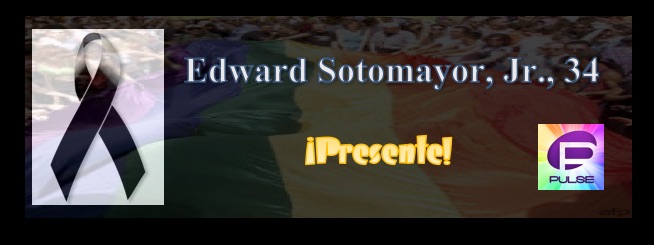
There is a tradition among Latin American Christians of naming the martyrs and saints, especially recent ones, and after each name shouting "¡Presente!" (Present!).  In so doing they not only remember those who have died but sense and proclaim their presence among us.

I have thus put together this post, naming each of the 49 murdered during Latin night at the Pulse nightclub in Orlando FL on Sunday, 12 June 2016.

As you read the names, remember them, honor them, feel their presence making us stronger.

Memory eternal!


You may see their names here.  Names and more information and photos of many of them are found here.

--the BB